Socrates criticized writing as a lesser form of communication. A tool of the forgetful to use in record keeping and trade:
[Writers] will cease to exercise memory because they rely on that which is written, calling things to remembrance no longer from within themselves, but by means of external marks.
Plato “Phaedrus”
The introduction of the printing press was not universally welcomed as a tool to make the production of the written word easier. The telegraph? Let me give you Thoreau’s take:
Our inventions are wont to be pretty toys, which distract our attention from serious things. They are but improved means to an unimproved end,… We are in great haste to construct a magnetic telegraph from Maine to Texas; but Maine and Texas, it may be, have nothing important to communicate.
Walden
The radio, telephone, and television also promised to fundamentally worsen interpersonal communication. The English language survived, mostly unscathed. Most of the high school English curriculum was written prior to 1960, and students do not struggle comprehend the English of American authors from the turn of the century.
However, the rise of the internet, specifically Amazon shopping and Google, may fundamentally change English grammar.
Without requiring formal study, native English speakers understand how to order words in a sentence. When describing an object, the descriptors generally lead the object of description. I have a red notebook. I use a large, yellow, fine-tipped, mechanical pencil. The general form of adjective placement for the English language is that adjectives precede the word they describe in the following order: Opinion; size; physical condition; shape; age; color; origin; material; purpose.
Not all languages follow this order. If I were to translate both sentences to French, they would translate literally as: I have a notebook red. I use a large mechanical pencil (mechanical pencil is a single word, so order of those words are irrelevant) yellow with a fine tip.
Most adjectives in French follow the object they describe. The same is true for Spanish and other romance languages.
Many aspects of computing follow the romance structure of object then adjective. When storing or retrieving data, programs basically write a sentence, in the form of a script, that requests information from another part of the application or database. The “computing sentence” is most efficient and clearest when adjectives follow the object they describe. Although this phrasing might seem complex, let me introduce a familiar scenario.
When shopping for a red notebook on Amazon, I can either search for “Red Notebook” or “Notebook Red.” Both will take me to a shopping page full of red notebooks. In the search process; however Amazon takes a different route to find those notebooks.

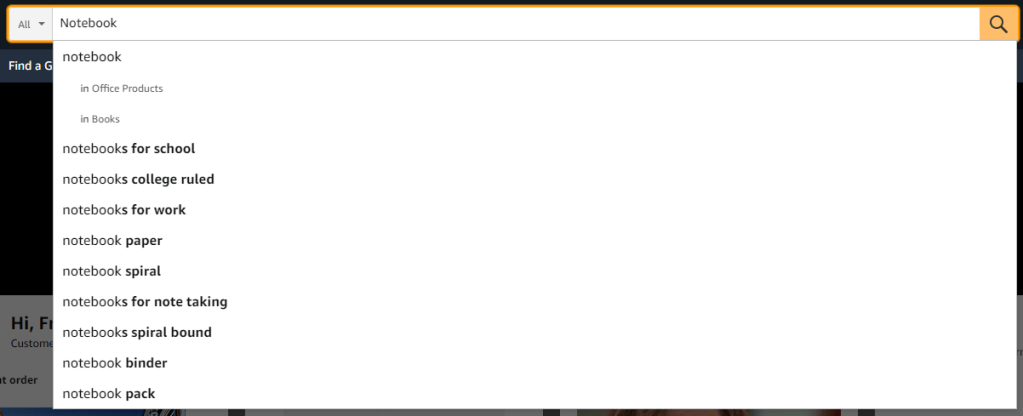
In this small search, the order doesn’t matter too much. Amazon has a powerful search engine and will react quickly to each new word. However, the path to the right notebook is more efficient when starting with notebook as my search term. When I type notebook first, Amazon recommends related searches and will limit suggestions to items related to notebooks. When I start with the word red, Amazon has to guess the next word based on the universe of items that could be red.

Computers are most efficient when objects are followed by descriptors. English speakers may find it more efficient to follow objects with descriptors in their internet search as well.
To revisit the red notebook example: When I search for a red notebook on Amazon, I’m given over 2000 results. Some are large, some are lined, some are bright, some belong with red fish, some with blue fish, some with one fish, some with two fish. To narrow my search, I add subsequent descriptors to my search. When I start with “red notebook,” I’ll likely end up with “red notebook hardcover lined 9×13” before finding few enough options to manually review. “Red notebook hardcover lined 9×13” does not follow any English grammar rules, and its uncomfortable to type. Amazon recommends additional words after my search, I end up with the unwieldy search by continuing to click the best fitting recommendations after each subsequent search. When I start with red notebook, Amazon recommends hardcover or paperback. I click hardcover. Still too many responses, I add a space to my search. Amazon recommends sizes. I click on the size. Too many responses. Etc.
Google works this way as well. When I search for something online and find too many results, I add additional criteria. That exercise of searching for an item and adding criteria with each subsequent search, is ultimately the same structure that Romance languages use in normal speech.
The advent of new technologies has certainly changed the English language. We have words to describe moving pictures, the internet, computer programming, and yellow fine-tipped mechanical pencils. However, these changes have been marginal. The internet, TV, and radio each added or standardized or added thousands of words, but the basic structure remained in tact. To call back to the beginning of the post, English teachers love to force Victorian literature on their students.
If the internet causes a single foundational, lasting change on the language, I think it will be a gradual shift in adjective order. Adjectives after the objects they describe are more efficient for the computer, more intuitive for online search, and are the norm for many other languages speakers that frequently use new technology. If English speakers continue to use online search for the next fifty years, and more people use voice recognition search, would it be crazy to think that the adjective order of the language will shift?
 Polly Wanna Math