I am the third of my name. The concept of heritage and genealogy were important aspects of my childhood. My last name is derived from the word armor-maker in French. The spelling and pronunciation changed with each new location and set of cultural influences my forefathers faced. We tell many stories within my family about our history and for the first time have the ability to add to, or in some cases disprove, the stories that shape my family’s self-conception.
Genetic testing solutions allow consumers to learn more about themselves and identify unknown relatives. The vendors that provide these tests, such as 23&Me or Ancestry promise to provide recipients with information about their health predisposition, their family tree, their physical traits, and their ancestry data. These promises present a compelling sales pitch to a person so enveloped by the stories passed down from generation to generation.
But I will not participate in genetic testing. At least not now. While learning about my past is important to me, it is the future that will prevent me from participating in any of the genetic testing services.
My genetic information is not just my own. If I am fortunate enough to have any children, they will inherit 50% of my DNA. My DNA belongs to them as well, and they cannot consent to having their genetic data shared with a 3rd party service. If there are consequences to my decision to receive genetic testing services, they would be powerless to combat them and likely just as vulnerable to those consequences as I am.
The United States has long realized the value of protecting an individuals personally-identifying health information. This information, covered as protected health information (PHI) is regulated under federal law (HIPAA) to prevent healthcare organizations from misusing or inappropriately distributing health data. Secure health information is critically important to a person’s safety, psychological and physical.
Let us consider a world without these protections. Imagine an elderly man who is suffering from a disease that may prove fatal previously had his health records distributed. Big Pharma buys those records and targets him with personalize adds that push unproven medication at high cost. Does that man have the presence of mind to consider those treatments rationally? Or does this predatory advertisement scheme, made possible by the release of health data, place this person facing his death in a psychological space that will result in overspending and potentially accepting treatment that lowers his quality of life. Consider a young gay consultant that travels internationally for work. Professionally, she keeps her sexuality private. Due to her medical records being sold, her clients based in a conservative country find out her sexual orientation and fire her.
These DNA test companies are not covered under HIPAA. The United States does not have a legal structure to suitably regulate what these companies do with their data. When these companies promise to provide reports on the recipients genetic indicators, physical traits, and medical predispositions, they are promising they have data that make the above scenarios possible.
The described scenarios are not only conspiracy fodder. DNA is not sufficiently protected and some of the privacy concerns have been proven valid. One of the DNA testing companies had a DNA breech in 2019 that revealed genetic and demographic data for 3,000 individuals. Law enforcement officers can require arrestees to take a DNA test without a warrant. In April 2018, US law enforcement legally used an online DNA match to catch a suspect, judges compelled the testing provider to open their database to a police search.
If US law enforcement’s use of DNA or a small leak are not sufficiently compelling, 60 Minutes ran an interview with Bill Evanina, the former director of the National Counterintelligence and Security Center, about China’s desire to collect American DNA data. I’ve added an excerpt below:
Current estimates are that 80% of American adults have had all of their personally identifiable information stolen by the Communist Party of China. The concern is that the Chinese regime is taking all that information about us – what we eat, how we live, when we exercise and sleep – and then combining it with our DNA data…
…Part of the social control includes the forced collection of DNA. Under the guise of free physicals for Uyghurs, Richardson says China is actually collecting DNAand other biometric data that’s then used specifically to identify people, target other family members and refine facial recognition software. And those, national security officials say, are just the uses we know about.
Currently, both Ancestory.com and 23andMe (the two biggest vendors in this space) claim strong privacy policies, and even allow users to delete some of their data (at the expense of future updates) that are designed to give their customers confidence that their data will be used responsibly and held securely.
That may be true.
But without a regulatory system that enforces genetic privacy, ensures total transparency on the transfer of genetic and demographic data and levies harsh punishment on data breeches, the risk of misuse is too high for me.
A final consideration. In 2018, U.K pharmacy giant GlaxoSmithKline invested $300 million in 23andMe, which included some exclusive access to 23andMe’s database. In December 2020, Blackstone Group, a global investment firm, bought Ancestry.com for $4.7 billion. In both cases users who purchased genetic tests prior to the investment/purchase now have their data managed or available to a corporation they may not trust as much as the company they purchased the test from. And given the sums invested, would it be rational to expect that these investors plan to maintain this store of priceless data without capitalizing on it?
For a few days at the end of January 2021, GameStop, a brick-and-mortar video games retailer commanded every news headline. The company’s stock price, valued at $2.57 a share in April 2020, rocketed to a high of $483 a share on January 28, 2021. The company, formally valued around $300 million in market cap, was briefly worth $25 billion. There were no changes in the business that accounted for the change in price.
As of February 12, GameStop is trading at $52.40 a share. More than the paltry $3, but nowhere near its high. The GameStop rollercoaster is over.
Or is it? Although the stock price is beginning to level out, the controversy around GameStop is not yet over. After the stock price jump, and subsequent fall, market insiders and retail investors have started asking for additional regulation to protect their interests. The regulatory response battle will be a long one.
Hedge funds shorted the stock and there was opportunity to profit from a “squeeze.”
The second reason requires a little bit of explanation. John Cochrane describes the short selling process clearly in his blog:
Here’s how it works. A has GameStop shares. B, the short seller, borrows those shares from A, and sells them to C. Now both A and C can have long positions in the stock. We have doubled the supply of shares. Alas, this mechanism is imperfect. It only lasts a day. B must be ready to buy back the shares the next day and return them to A.
The shorts have two options, if the price does not fall:
Close the position– Pay the market value + interest for the stock to buy the underlying shares. Because B has to buy the stock at market value (that did not fall), B owns the shares and the price of the stock increases due to the increased demand.
Roll the position –B does not need to give the stock back on day 2, instead paying more interest each day to continue borrowing the shares from A.
The short selling of GameStop was so prolific that the shorts (B) borrowed more shares than have been issued. The WallStreetBets Reddit and YouTube communities jumped on the opportunity to buy shares, in the expectation that the shares would have to be bought at higher prices by the short selling entities. These communities have become increasingly large over the last few years, corresponding with the rise of fee-free brokers. Fee-free brokers with applications, such as Robinhood, allow individuals with any sum of money (the average account is less than $5,000 and owned by a 31-year-old) to participate in the stock market. Robinhood has over 13 million users; at the GameStop trading peak, analysts predict that nearly 50% of Robinhood users bought GameStop.
The squeeze started on January 12. On January 12, the stock closed at $19.95 per share. January 13? $31.40. January 25, $76.79. January 26:
January 27 closed at $347.51 per share. By February 2, the stock closed under $100 a share and the principle short sellers had closed their positions.
How did institutions respond?
During the period between January 26 and February 2, the stock was halted or paused a number of times by brokers and the New York Stock Exchange.
Robinhood, and similar broker-apps, restricted trading of GameStop and other highly volatile securities during this time. Users were, at times unable to purchase more shares or options of GameStop. Other application users reported that Robinhood actively sold their shares or options of the company, at low prices. Retail investors, understandably complained and demanded action from Washington:
LMAO omg I love when ppl w differences come together. Beautiful day out here on Twitter pic.twitter.com/uQ9xBany2j
These brokers were quick to respond that they were forced to halt stocks and restrict ownership based on current regulation or clearinghouse requirements.
When a Robinhood user buys a stock it actually takes two days for the funds to be exchanged (SEC standard), in the interim, Robinhood must post the colleterial for its users’ purchases. Due to Dodd Frank regulation, clearinghouses must set collateral requirements based on concentration of ownership and volatility of a stock. These brokers are not able to use their clients money to post colleterial (the theory is that these restrictions will prevent brokers from irresponsibly losing investor money when they go bust). Depending on the broker, either the clearinghouse forced a halt trading on GameStop, or the broker no longer had the liquidity required to cover the collateral requirements for trading the stock. As an example, the largest clearing organization (DTCC) reported that the industry-wide collateral requirements jumped from $26 billion to 33.5 billion on January 28.
Large institutional traders did not have the same liquidity concerns and were not halted by their clearinghouse agreements from purchasing the stock, or its derivatives.
So who made money?
The GameStop short squeeze was billed as a David-and-Goliath story of Reddit users taking down hedge funds. That isn’t exactly what happened. Short sellers initially lost around $19 billion, but none shuttered. It’s true that Melvin Capital (the hedge fund with the largest short position) required a bailout of about $3 billion from other funds, but hedge funds as a whole were not defeated by the short squeeze. Who made all of the money from the stock increase?
Not retail, generally. GameStop saw a $20.4 billion gain in market cap. Nine investors, led by Fidelity and BlackRock, totaled a $16 billion return on the GameStop short squeeze. These 9 firms made 75% of the total gain.
The returns were mixed for retail investors. Some early retail investors saw significant gains from their GameStop investment, most bought over $100 per share and received only modest gains or, more frequently, losses. When Robinhood limited its users’ ability to purchase stock or sold shares purchased with unsettled funds, retail investors were prevented from capitalizing on potential money making opportunities.
Will it happen again?
I am not a financial advisor, nor do I give financial advice. I am speculating on the frequency of a similar short scenario; rather than on the performance of any individual stock.
For a short squeeze of this magnitude, institutional players must have interests on both sides. Michael Burry and other investors publicly announced long positions in the company. Short institutional firms announced their interests as well. These types of public battles don’t occur often. Firms that take anti-shorting actions tend to have very low returns, making them unlikely targets for long-term value investors. For all of the publicity Robinhood and WallStreetBets received in the GameStop narrative, they did not have the power to push the GameStop stock alone. As noted above, the firms that cashed in on the run were major hedge funds. Institutional money was required to generate the momentum in the stock price.
Second, the short interest in GameStop was greater than the number of shares in circulation. As of February 12 2021, there are no companies in the S&P 1500 with short interest over 100%. While short squeezes occur with short interest well under 100%, the magnitude will not reach GameStop levels.
Retail short squeezes might become more common though. Small retail investors will attempt to replicate the GameStop experience on other stocks. Chat rooms, Reddit, and YouTube are not diminishing in size. The WallStreetBets Subreddit (community blog) grew by 2.4 million subscribers during the GameStop short squeeze.
Robinhood continues to grow as well. The tool enables small retail investors to trade stocks, as well as more complex derivatives, without fee. The rise in this app enabled a major rise in speculative investment by individual retail investors (the common folk).
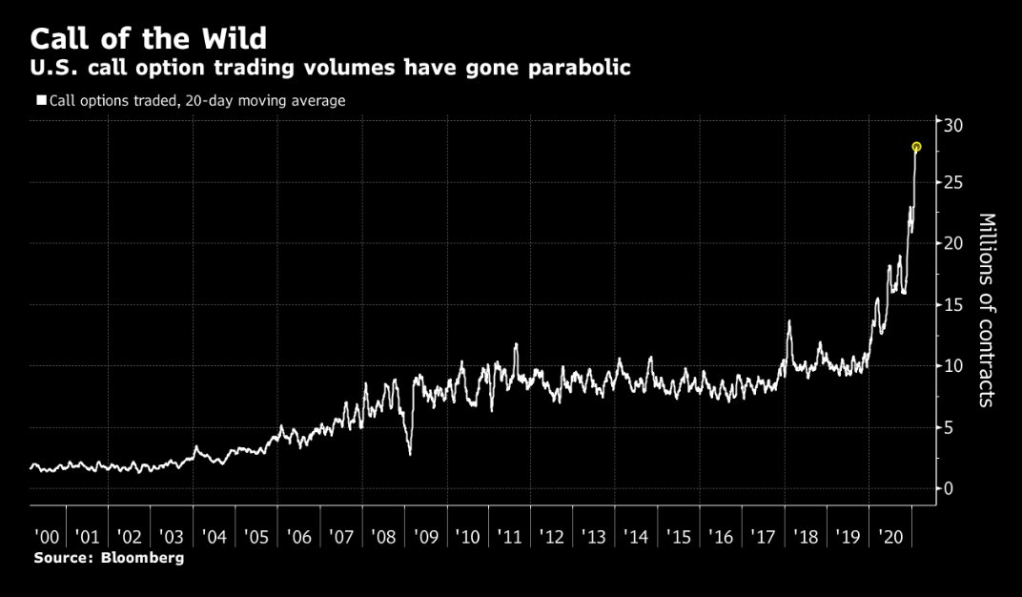
After the introduction of transaction-free brokers, such as Robinhood, the number of options traded skyrocketed.
Another GameStop is unlikely, but the increase of speculative investing by small retail accounts will fundamentally change the trading behavior of some stocks. About a year ago, WallStreetBets pushed the stock of Lumber Liquidators through community action. The Lumber Liquidators example is more representative of the market power of the WallStreeBets community. I anticipate more of those stories as the platform grows and barriers to trading are removed through applications such as Robinhood.
If it’s unlikely to happen often, why should I expect regulatory action?
Regulators are receiving pressure from institutions and retail investors to prevent similar situations from happening. On the institutional side, the demand for regulation includes a crackdown on these forums to prevent coordination on certain stock strategies. Institutions calling for greater regulation of social media coordination point to the behavior as a form of market manipulation. GameStop is not the only stock that had a semi-coordinate strategy. The WallStreetBets community tried, to a lesser extent, to exert the same pressure on AMC, Nokia, and BlackBerry.
Retail investors are arguing for regulation that would further democratize the stock market. The nature of these regulations would be to open the number of investment vehicles available for retail investors, to protect trading chat rooms (CNBC is allowed to exist, how is a Reddit forum discussing stocks fundamentally different), prevent clearinghouses from being able to raise collateral requirements in a manner that restricts retail trading.
Although the nature of the regulation that will be introduced is unclear, it’s reasonable to expect a regulatory response. Treasury Secretary Yellen scheduled meetings with the SEC, the Federal Reserve Board, the New York Fed and the Commodities Futures Trading Commission to discuss the recent events in the market. Given the Tweets above, members of Congress are interested in proposing regulation as well. The CEOs of Robinhood and Reddit will testify this month before a House Committee.
Our regulatory system does a lot in the name of “protection” to keep people of low means away from the kinds of investments that wealthy people can access. I think it is likely that the majority of the regulation that comes from the GameStop hearings will attempt to limit “risky” retail behavior, rather than open the market further. I anticipate at least some of the following regulations will be put into place:
Small-broker applications will be reclassified as gambling applications and regulated in the same manner as sportsbooks (state-level)
Small-broker applications will need to change their user interface to reduce gamification of stock trading
Create minimum equity requirements on trading accounts that are able to trade derivatives
Create a framework for the SEC to hold forums accountable for any coordination on stocks that occurs on the platform
Although the GameStop story received a lot of press, its impact on the stock market and financial institutions of the United States was marginal. Any of the likely regulations above would almost certainly do more harm than was created by the GameStop short squeeze.
*Addendum–The relationship between broker applications and organization that purchase order flow was not addressed at all in this write-up. The example commonly found in the news is a relationship between Citadel and Robinhood. I intentionally left it out because it is not unique to the GameStop scenario, nor does it related to the underlying activity; however, I see these relationships as an area fertile for proposed regulation.
Economists are constantly inventing new weighing mechanisms to evaluate the overall health of the economy. Because the US economy is a massive, ever-changing, complex system comprised of independent and semidependent actors, no single number or equation has sufficed to gauge the heath of the economy.
I will not present a grand unifying economic theory.
Economists track a number of economic indicators to determine the health of the economy. Some indicators are leading, meaning they predict changes in the greater economy. Others are trailing, meaning they measure factors of the economy that already occurred. Given the complexity and velocity of the macro-economy, it operates with a sort of Heisenberg uncertainty principle that prevents a truly current understanding of economic health.
One of the most important leading economic indicators that policy makers use is the Consumer Confidence Index (CCI). The Consumer Confidence Index tracks responses to a monthly survey sent to consumers about their perceptions for business, employment, and income for the next six-months. Currently, the model indicates that the US is at lower-than-average confidence; however, I have reason to doubt the results.
Allow me to propose one more model for consideration. The percentage of “_________ as a Service” sales compared to total sales for the following industries:
Tech (enterprise, personal, and public sector)
Food
Automotive (leases)
Consumer non-durables
“_______ as a Service” or XaaS describes a model where consumers purchase a subscription for a product, rather than the product itself. In these agreements, the consumer pays a regular payment in exchange for usage of the product and the necessary support to maintain the product. At the end of the agreement, the consumer has no right to the product and must purchase a new subscription to continue use. Automotive leases are an example of cars as a service: consumers pay a lease to use the car each month and for the dealership to handle maintenance through the lease period.
Purchasing anything as a service requires confidence in an ability to pay for the product through and after the subscription term. If I anticipate a huge pay cut in three years, I will not start a lease. Instead, I’ll purchase a less expensive vehicle (finance if needed) that I will retain after my payments are through. Similarly, I’d purchase Microsoft Office (perpetual license), over Microsoft 365 for my personal or business use, if I had concerns about future cash flow.
Providing products as a service requires confidence from suppliers as well. If I anticipate high inflation I wouldn’t sell any subscription that locks consumers into today’s prices. In a period of high inflation, I either want to make one-time sales today or To continue the car lease example:
A dealership anticipates a 10% inflation rate over the next year. In real terms, that means that a $200/month lease today is worth $180 monthly in one year*. As a result, the dealership will encourage its sales staff to push sales over leases, or to encourage customers to wait and purchase the vehicle at a later time (because the car will sell for more nominal dollars). The lease option will lock the dealership into lower revenue for an inflationary period.
If the average consumer does not believe that she will be able to afford a subscription in the future, demand for subscriptions will fall. When producers anticipate that their products will be worth more in the future, they will not sell contracts at today’s prices. However, when both producers and consumers have confidence in the economy and their future income, the as a service model makes a lot of sense for both parties.
The “as a Service” model can cut costs and reduce time from purchasing to use for consumers. Reducing time to value is most applicable in a business-to-business context where new software deployments can take months, but holds true in the business-to-consumer landscape as well. Learning to cook and stocking a kitchen takes time and expense, consumers are increasingly shifting to Food-as-a-Service providers such as HelloFresh to manage the recipe creation and ingredient sourcing. HelloFresh allows consumers to have a “homecooked” meal much faster, and with less hassle, than the traditional grocery store process would have required. In the IT space, the as a service model reduces the physical overhead and resources that a consumer requires to support the product–the producer covers those costs with the subscription fee. Producers benefit from guaranteeing future recurring revenue and can reduce overhead through an economy of scale (by supporting all consumers). The “as a Service” model is so attractive to producers that Microsoft intentionally steers their consumers to the 365 subscriptions, rather than promote the purchase and subscription options.
The “as a Service model” is certainly booming. In 2018, Gartner predicted that “by 2020, all new entrants and 80% of haptoral vendors will offer subscription-based business models [in IT].” I could not find statistics to verify the accuracy of the claim, but it was directionally correct, at minimum. The growth rate of Microsoft 365 supports the claim.
Although the Consumer Confidence Index remains lower than historical average, the rise in XaaS agreements tells a contrary story. When confidence in both the economy and individual future purchasing power are high, XaaS arrangements are mutually beneficial. I anticipate that a reduction in the Xaas industry will be a leading indicator of falling economic confidence or a rise in inflation–both important economic indicators.
*I acknowledge the relationship between inflation and future payments isn’t as simple as stated. Financing, Net Present Value, and disparate effects of inflation create a more nuanced interaction of monthly lease payment and real value.
The US government should take action that bolsters the US economy, even after the pandemic subsides, without writing blank checks to US corporations.
Why not continue direct investment in US corporations? The United States Congress already provided $25 billion in bailout funds to airlines alone this year, and House Democrats are pushing for more.
The United States Congress should sanction a World’s Fair for the summer of 2021 or 2022 depending on the anticipated longevity of the COVID pandemic.
Although a proposal for a World’s Fair initially sounds like an immature policy response, I think it would be strong policy, both symbolically and economically, for the American people.
The World’s Fair, as I imagine, would focus on showcasing four aspects of American society:
A Brighter Future–How technology and the nation’s youth will bring the United States into its brighter future.
American Made–How Farming and Manufacturing make America.
E Pluribus Unum–How immigration and cultural appreciation create the World’s Melting Pot.
American Life–Sports, Theatre, Design, and Art
Ideally the Fair would be held for a few months in a city that had experience with significant air, bus and rail travel, and could hold hundreds of thousands of daily travelers. To ensure maximum economic benefit and avoid political entanglements, I’d propose to hold the convention in a mid-sized city, in the middle of the country. Omaha, Minneapolis, Indianapolis, Detroit, St. Louis, and Oklahoma City are likely candidates. Once the Fair finished, its exabits would travel to the marquee cities of the United States.
As a part of the policy funding, Congress would appropriate funds for grants associated with each of the four showcases and to subsidize travel/hotel costs for every American (at a graduated rate based on income). Additionally Congress would pay for the costs of the expeditions and for the traveling show; the winning city would need to allocate funds for the grounds and any city-specific exhibits.
The World’s Fair will jumpstart the aviation, busing, and rail industries. Symbolically, the subsidized travel will indicate to the population that it is safe to travel. Financially, it will allow millions of Americans to leave their home state for the first time, and bring in foreign travelers. Even after the Fair terminates, I anticipate many Americans and foreign citizens will travel more frequently than they would have without the encouragement.
Congress will add stipulations to the grants for each showcase that encourage competition in certain, popular and positive, arenas. For instance, the grants associated with youth and tech should promote changes to the education landscape, reduce the barriers for at-risk youth, and inspire future corporates leaders. The Farming grants would reward a return to suitable, local farming and encourage new small farmers.
In order for the World’s Fair to make a noticeable impact on the US economy or society, Congress will need to spend a lot on it. The last US World’s Fair (1984) failed because it didn’t receive the investment it needed. The US needs the cultural equivalent of a Ferris Wheel or Eiffel Tower (both World’s Fair inventions) to inspire confidence.
To make the endeavor palatable for both parties, the Fair will need to be sold as a support to the airline industries and to small-and-large businesses first. I propose the following funding sturcture:
40% of grant money to A Brighter Future
40% of grant money to American Made
10% of grant money to E Pluribus Unum
10% of grant money to American Life
In this structure, Republicans can promote the fact that farmers and manufacturers received a 40% of the overall funding, more than the “Liberal causes.” Democrats can sell the Fair as a celebration of culture and Art, 20% of trillions is a lot of funding for diversity and arts events. Both sides and the public should support the funding of children’s programs and the airline industry.
Obviously a single Fair will not save the airlines or build confidence and togetherness in the US economy. That should not be the goal. The Fair would save the airlines and hopefully bolster travel for years to come. The Fair should introduce youth to new cultures and business ideas. Ideally the Fair would inspire future economic growth both through the grant recipients, and for visitors who walk away inspirited with their personal ideas on how to build their brighter future.
We do not yet know the full impact of COVID-19 and its associated policies will have on American businesses. At present, tech, home improvement, and logistics companies are creating record profits. On the other end of the spectrum, airlines, entertainment, and foodservice are struggling.
The long-term status of these industries aren’t quite as clear. No one knows how long COVID-influenced policy and public behavior will disrupt business. The combination of government stimulus, work from home, and consumer spending changes has caused the stock market to soar through much of the pandemic, while many businesses suffered and unemployment spiked.
Seven months into the pandemic, economists struggle to quantify even the current state of the economy. The Bureau of Labor Statistics reported an .4% inflation rate during the month of August; however the inflation rate, which is a proxy measurement for the increase of decrease of the purchasing power of currency, requires a predetermined bundle of items whose price is tracked each month. That bundle does not reflect the consumer spending habits of 2020, and the inflation rate that consumers experience is not .4%, but the true rate is unknown. Similarly, studies that measure average income have been less accurate than usual in 2020. Based on the 2020 Household Pulse Survey, 25% of Americans expect a loss of household income within the next four weeks; however, median weekly earnings increased in Q2 2020. Together, these factors make it difficult to evaluate the status of the economy.
If given the opportunity to open any business now, I would open a crepe food truck. With the projections of restaurant failures and the decreased popularity of eating at a restaurant, food trucks will represent a better value proposition for entrepreneurs.
From a cost perspective, food trucks are possible to bootstrap. The start up costs of a food truck can be kept between 50 and 100 thousand dollars. For comparison a restaurant will cost, on average, $250,000. Crepe batter requires only three ingredients: Milk, eggs and flour. Fuel remains relatively cheap. The cost per serving will depend on the style of crepe and selected toppings.
From a revenue standpoint, the argument for food trucks is pretty strong right now. A number of cities have started to close streets to vehicles, to allow pedestrians more room for socially distanced dining. Food trucks are the perfect vehicle to capitalize on the closures in the short-term. Food trucks allow for socially distanced dining, delivery on app-based delivery services, and high throughput. These are key in a socially-distanced world.
Of course, the restaurant industry will come back eventually and people will be willing to eat inside. Will the food truck industry be in a stronger position in that time than it was prior to COVID?
Yes.
The industry has two primary drivers of potential growth accelerated by COVID. Food delivery is growing in the United States. COVID accelerated the growth, but the industry is here to stay. Food trucks can capitalize on this trend by moving to central locations of suburbs (which normally would not be popular) and sell both in-person and delivery orders. Food trucks will no longer be limited by population density of foot-traffic in the immediate vicinity. The other driver accelerated by COVID is the growth of civic outdoor space (hinted above). At least some of the streets converted into pedestrian walkways during COVID will remain that way. The increase in pedestrian areas will result in an increase in opportunity for the trucks.
Food trucks might be a good idea, but why crepes?
Crepes batter is easy to prepare. A crepe griddle is cheap compared to many cooking implements, training to make a crepe is incredibly easy, and crepes offer immense flexibility. If I were to make an October crepe menu, it might have the following items:
In the summer, my menu would play to the in-season fruit. For a morning event, the crepe truck would have all of the classic bagel options of a deli. For special events, a design your own option would be available. The crepe offers a more distinctive identity than a sandwich truck, but much more flexibility than an ethnicity- or ingredient- specific truck.
 Polly Wanna Math