Education, Politics

An Analogy For Those Brave Enough to Discuss CRT

I wasn’t planning to discuss Critical Race Theory (CRT) on this blog for a few reasons:

  • I thought the controversy surrounding it would be a flash in a pan
  • Critical Race Theory isn’t formalized or defined well enough to review meaningfully
  • I’ve seen no evidence that teaching the core tenants of Critical Race Theory in a classroom leads to positive or negative educational or social outcomes

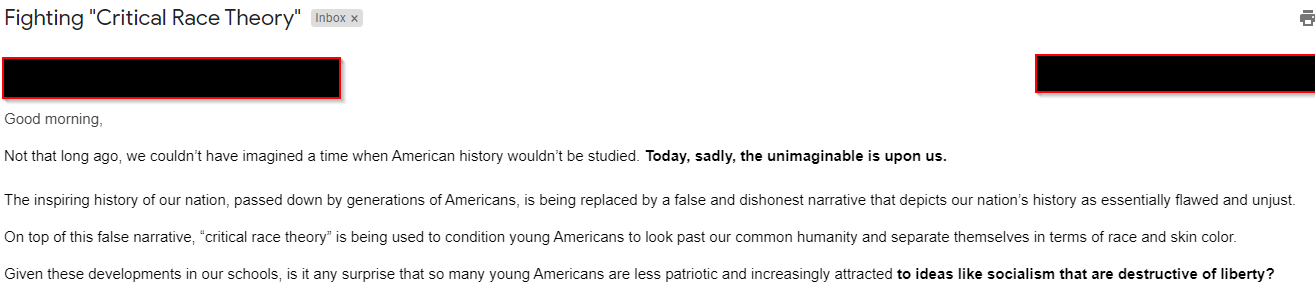
However, Critical Race Theory continues to play a major role in conservative rhetoric and I think it will likely show up in middle or high school civics courses. After receiving an email (excerpts below) about the dangers of CRT, I found it important that I could come up with an analogy that I could use with friends and family to discuss Critical Race Theory without alienating people on one side or the other.

The Email:

email
Name hidden

The Analogy:

Have you ever noticed that left-handed people struggle with things that come naturally to right-handers, such as writing, using scissors, and opening cans? Why is that?

The obvious reason is that our world was built for right handed people. Replace left-handers with people of color and that is the core tenant of Critical Race Theory. The specific items that are hard don’t matter much, the point of the analogy is that the world was designed so that it worked best for the people that were in charge of shaping it.

The Conversations:

The other aspect of Critical Race Theory is how to deal with that built-in inequity and to what extent it must be resolved. This analogy does not attempt to guide a conversation on what the “right” outcome is. Ideally, this analogy fosters that discussion. Once all parties understand the core principle of CRT, how it should or shouldn’t be used should be fertile ground for constructive ideas-based conversation.

Without being able to ground discussions about CRT in something that is generally understood, I fear too many of the conversations will sound like the email above reads.

Want to learn more?

I’ve complied a few resources I’ve used to learn more about about CRT:

Education, Observations

Spicy Take: How well do you understand your bicycle?

How well do you know how a bicycle works? Many of you, myself included would have said “very well.” I learned to ride a bicycle as a toddler and, although I don’t ride frequently now, I’m very familiar with bicycles. Or I thought I was. I recently read an article that asked the following questions about bicycles to other people who reported to be familiar:

Could you draw one? Artistic skill aside, could you identify a picture of a functional bicycle against non-working photos?

The Science of Cycology: can you draw a bicycle?

40% of people in the survey made a fundamental mistake in drawing how a bicycle’s chain functions. This survey built on a 2002 study that found people rate themselves as having a far greater level of understanding of complex phenomena before being asked to describe its mechanics than they report after having to give a description. The study coined the phrase the illusion of explanatory depth.

The illusion of explanatory depth is phenomenon where individuals believe they understand the world with far greater detail than they actually do. The illusion of explanatory depth is not a function of blind overconfidence, or a person’s inability to admit ignorance; rather it is a function of a miscalibration of a person’s ability to understand and explain complex systems with detail. Because I interact with my refrigerator daily, and am familiar with what it does, I am pretty sure I know how it works. Or I have a pretty good idea, until I have to diagram or explain how it works.

Self-testing one’s knowledge of explanations is difficult. Testing knowledge of facts is easy. I either know that coriander and cilantro are the same plant or I don’t; it is much harder for me to challenge myself on what exactly coriander brings to a dish and how it changes the flavor of my food. Even when I am able to test myself, it’s harder for me to hold myself accountable; systems are harder to Google.

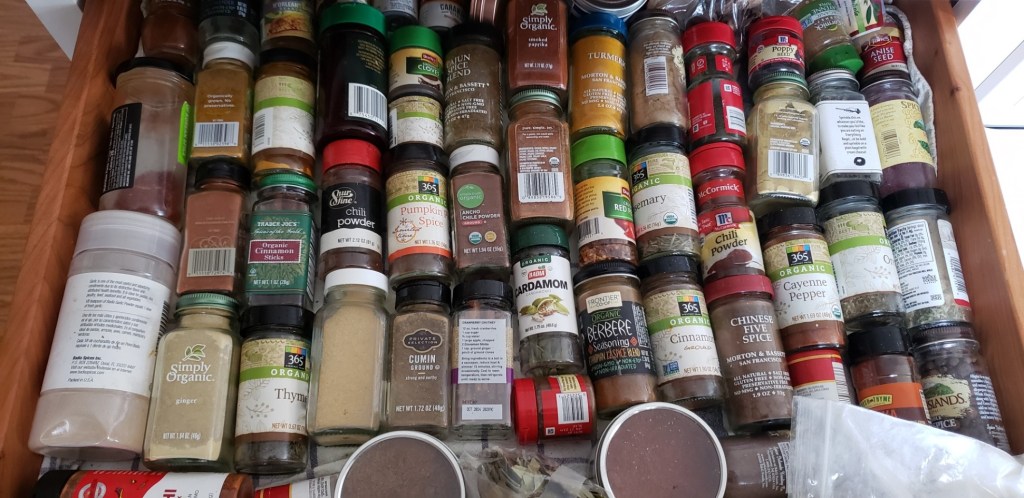
I recently had the opportunity to test my understanding of complex systems that I felt insatiately familiar with–my own cooking. I knew that I add oregano to my sauce when I make spaghetti, and cumin to a Middle Eastern inspired chicken dish. When I add these spices, am I adding them because I am looking to bolster or change a certain quality of the food, or because I know that the spices “belong” with the dish.

To test my knowledge of the spices in my kitchen I wrote down my impressions of each spice in my spice drawer:

Yeah, I know I should have more whole spices.

I described no fewer than three spices as “warm and earthy.” How would one describe cinnamon? How does that description differ from turmeric? Allspice? How about garlic? Onion? I was amazed at how poorly I described spices that I used daily:

After a confidence-crushing attempt, I wanted to compare my pre-tasting notes with my experience tasting each spice individually. I set up a spice tasting:

  • First, I poured about a 1/4 teaspoon of a spice on to a plate and smelled it. I recorded my impressions on an index card.
  • Second, I tasted the spice from the plate and wrote my impressions on the same index card.
  • Third, I toasted the spice in a pan and noted how both the smell and flavor changed after toasting.
  • Between each taste, I took a bite of an apple to cleanse my palate. Between each smell, I smelled a ramakin filled with coffee grounds.

I ended with a series of notecards (pictured below) that captured a much more accurate and personal description of the spice. During the tasting, I found that I was able to describe, with much more precision, flavors and smells that I was confident I knew prior.

My handwriting did not improve that afternoon.

Exploring my spice jar with intention was humbling and promises to be helpful in future food endeavors; but isn’t exactly profound. In his recent book, The Data Detective: Ten Easy Rules to Make Sense of Statistics, Tim Harford presents examples of how the illusion of explanatory depth heightens political polarization. Study respondents who had strong views on complex policies, such has cap-and-trade programs, were more willing to alter their views after being asked to describe the program. These study respondents realized, as I did about my own cooking, that they had miscalibrated how much they actually understood the mechanics of the programs they were previously passionate about.

Understanding how the illusion of explanatory depth impacts our worldview is helpful, but does not solve the problem that self-testing one’s knowledge of explanations is difficult. There is at least one tried-and-true method:

If you want to learn something, try teaching it.

Richard Feynman

The Feynman technique is a four step process to learning something. It can be applied to physical skills, fleshing out ideas, or confirming your reading of the daily news. The steps are as follows:

  • Identify the subject
  • Explain it to a child (or an imaginary child)
  • When part of your description is missing detail or a link between information, study the gaps in your knowledge
  • Simplify, fill the knowledge gaps, and explain again

The act of explaining concepts is a natural test to determine how well we understand the components of complex phenomena. Teaching disrupts the illusion of explanatory depth, because it requires explanatory depth.

How well do you know your bicycle, food, or passionate views?

Want to learn more about the idea of illusion of explanatory depth? Find more below:

Business, Education, Innovation, Technology

Post-Pandemic-Policy-Proposal

I find it likely that the United States will experience a new or worsening recession within the next year. Even the most optimistic economic projections anticipate that travel will remain depressed, the hospitality industry will recover slowly, and that direct stimulus will end.

The US government should take action that bolsters the US economy, even after the pandemic subsides, without writing blank checks to US corporations.

Why not continue direct investment in US corporations? The United States Congress already provided $25 billion in bailout funds to airlines alone this year, and House Democrats are pushing for more.

Airline bailouts, in particular, are ineffective and unpopular. There are some indications that Americans’ trust of large corporations is shrinking, and corporate bailouts don’t necessarily increase the prospects of the American worker.

A perfect post-pandemic-policy proposal to aid the US recovery will need to address a few concerns:

  • It needs to be popular with the public and both parties to pass into legislation
  • The policy will need to help the travel industry
  • Their must be a fiscal multiplier to funds allocated to the policy

What do I recommend?

A World’s Fair.

The United States Congress should sanction a World’s Fair for the summer of 2021 or 2022 depending on the anticipated longevity of the COVID pandemic.

Although a proposal for a World’s Fair initially sounds like an immature policy response, I think it would be strong policy, both symbolically and economically, for the American people.

The World’s Fair, as I imagine, would focus on showcasing four aspects of American society:

  • A Brighter Future–How technology and the nation’s youth will bring the United States into its brighter future.
  • American Made–How Farming and Manufacturing make America.
  • E Pluribus Unum–How immigration and cultural appreciation create the World’s Melting Pot.
  • American Life–Sports, Theatre, Design, and Art

Ideally the Fair would be held for a few months in a city that had experience with significant air, bus and rail travel, and could hold hundreds of thousands of daily travelers. To ensure maximum economic benefit and avoid political entanglements, I’d propose to hold the convention in a mid-sized city, in the middle of the country. Omaha, Minneapolis, Indianapolis, Detroit, St. Louis, and Oklahoma City are likely candidates. Once the Fair finished, its exabits would travel to the marquee cities of the United States.

As a part of the policy funding, Congress would appropriate funds for grants associated with each of the four showcases and to subsidize travel/hotel costs for every American (at a graduated rate based on income). Additionally Congress would pay for the costs of the expeditions and for the traveling show; the winning city would need to allocate funds for the grounds and any city-specific exhibits.

The World’s Fair will jumpstart the aviation, busing, and rail industries. Symbolically, the subsidized travel will indicate to the population that it is safe to travel. Financially, it will allow millions of Americans to leave their home state for the first time, and bring in foreign travelers. Even after the Fair terminates, I anticipate many Americans and foreign citizens will travel more frequently than they would have without the encouragement.

Congress will add stipulations to the grants for each showcase that encourage competition in certain, popular and positive, arenas. For instance, the grants associated with youth and tech should promote changes to the education landscape, reduce the barriers for at-risk youth, and inspire future corporates leaders. The Farming grants would reward a return to suitable, local farming and encourage new small farmers.

In order for the World’s Fair to make a noticeable impact on the US economy or society, Congress will need to spend a lot on it. The last US World’s Fair (1984) failed because it didn’t receive the investment it needed. The US needs the cultural equivalent of a Ferris Wheel or Eiffel Tower (both World’s Fair inventions) to inspire confidence.

To make the endeavor palatable for both parties, the Fair will need to be sold as a support to the airline industries and to small-and-large businesses first. I propose the following funding sturcture:

  • 40% of grant money to A Brighter Future
  • 40% of grant money to American Made
  • 10% of grant money to E Pluribus Unum
  • 10% of grant money to American Life

In this structure, Republicans can promote the fact that farmers and manufacturers received a 40% of the overall funding, more than the “Liberal causes.” Democrats can sell the Fair as a celebration of culture and Art, 20% of trillions is a lot of funding for diversity and arts events. Both sides and the public should support the funding of children’s programs and the airline industry.

Obviously a single Fair will not save the airlines or build confidence and togetherness in the US economy. That should not be the goal. The Fair would save the airlines and hopefully bolster travel for years to come. The Fair should introduce youth to new cultures and business ideas. Ideally the Fair would inspire future economic growth both through the grant recipients, and for visitors who walk away inspirited with their personal ideas on how to build their brighter future.
Education, Observations, Prediction, Technology, words words words

What Cooking Taught Me About Online Education

I aspire to be a moderately successful home cook. I have a few specialties and can cobble together a decent meal each night, but I clearly lack fundamental skills. My vegetables, rice and pasta look rustic at best. I dedicated the last weekend to improving all three. My goal was to create one batch of sticky rice and one plate of pasta that passed muster.

Did I do it? You should know that if a blog describes cooking, you’ll have to endure a novel before you are permitted to see the results.

I’ve read a number of cookbooks, watched Masterclasses, and YouTube videos to improve my technique. I found some to be incredibly helpful, Jacque Pepin’s knife skills are a perfect primer. Joshua Weissman offers a good series on how to cook at home. But after a weekend of practice, I learned as much about remote education as I did about cooking.

Students have a number of learning styles. Schools attempt to incorporate a multitude of learning styles in their instruction. The VARK model is a widely-used schema for cataloging learning preference that educators use to vary instruction. In the VARK model, there are four types of learners:

  • Visual–learners that best internalize and synthesize graphic information such as charts, diagrams, hierarchies.
  • Auditory–learners who succeed when they have the opportunity to listen and wrestle with concepts verbally.
  • Reading–These are good students (I kid). Reading/writing learners are best when given the opportunity to read and write about their subject matter.
  • Kinesthetic–For these students, learning is a physically active endeavor.

One can argue how well the public school system caters to each style, if the VARK model is an appropriate way to classify learning styles, or if learning styles exist. However, when I was attempting to better my cooking this weekend, it was clear that all of the learning styles referenced above were available to me. I listened to and watched videos (Visual/Auditory). I rolled dough, and rolled dough, and rolled some more (kinesthetic). I read recipes and descriptions (Visual). I’ve considered myself a visual-spatial learner, and had no problem learning through the combination of media available to me. On-line education upheld its promise.

Yet, something was missing in my culinary lessons. I wasn’t always improving batch-to-batch. Learning models frequently focus on how to plan lessons and engage students, but rarely outline the best way to curb bad outcomes or patterns. I intuitively know that I wouldn’t benefit as much from a golf lesson over Zoom, as I would in person. My swing needs physical correction and don’t have the spatial awareness necessary to correct from words alone. Similarly, I wouldn’t want to take a music lesson without an instructor present to help correct breathing, posture and adjust my movements in real-time.

After a weekend, I made incremental improvement in my ability to roll pasta and cut noodles, make sushi rice, and consistently cut a range of vegetables. I would have improved faster if I received real-time physical corrections. Practice does not make perfect, practice makes permanent. Without immediate correction, I’ve further entrenched bad habits that I hope to learn enough to correct later. When learning to cook online, I learned my personal limit with the available media.

Not perfect, but an improvement over past attempts.

Many students will return to academia online this coming semester. Invariably, these students will miss out on a number of intangible benefits of traditional education. In addition, I worry that these students will miss out on having their bad outcomes or patterns corrected. Will it be as easy to foster challenging intellectual conversation over the Web? Will educators be able to help students course correct in any academic discipline in video lessons?

Remote pedagogy might be the best course of action for many this autumn. That is not a topic I want to engage. However, I predict that remote learning will benefit the students of math, technology, and the sciences. I won’t be surprised when it results in poor outcomes in philosophy, history, language and elective courses. I won’t be surprised when remote learning constraints are further used to reduce funding of the Arts. Remote learning is probably not suited for disciplines of nuance that require gentle but constant and immediate corrections from an engaged educator.

Education, Observations

Things education in the US can’t stand: People who are intolerant of other people’s cultures, and the Dutch.

Forgive the Austin Powers reference, I haven’t blogged in a while and I’ve regressed as a result. Throw me a frickin’ bone here. On the topic of Austin Powers, there is a scene where Mr. Powers is attempting to get up to speed on decades of American history in a single night. He sums it up in a single sentence, “Jimi Hendrix Deceased, Drugs. Janis Joplin Deceased, Alcohol. Mama Cass Deceased, Ham Sandwich.”

While I was in middle and high school, there was a shift away from teaching students an Anglocentric history. Our books primarily taught US history still, but there was an increased focus on the social history and experience of American Indians, women, and, later, immigrant populations. When studying world history, China loomed as large as Rome. Generally, I think the shift away from Anglocentric, whig history is a positive step. Students should be exposed to history that connects with them, history should be taught in an inclusive way that contextualizes history with the cultures, influences, and aftershocks that make up the events taught in class.

With an increased focus on the individual cultures and peoples that built the United States, one might assume that US students learn more about the Dutch element of US history. The Dutch gave us Santa Claus, New York, doughnuts, and brought African slavery to the Colonies. Despite the influence that the Dutch had on the form of the US government, stance on religious tolerance, and economic growth through the Dutch East India Company, the AP US history curriculum devotes more attention to Spanish colonialization than the influence of the Dutch on the US.

I think the lack of focus on the Dutch has a couple of causes:

  • Dutch influence is hard to separate from English influence and it is much easier to teach the English narrative.
  • The golden age of the Netherlands occupies a period of time not focused on in US history.
    • Students generally learn about the founding of the colonies, and then jump to the war for independence. Any time devoted to the 1600’s tends to focus on American Indian relations and religious tolerance. The Dutch aren’t necessary to teach either.
  • There is no cultural/political benefit to separating the Dutch from other subsets of white, western history.
    • The Dutch are definitionally WASPs and benefited from whig history, spending time focusing on their contributions might diminish the benefits of the more contextualized history taught today.
    • Dutch culture is German culture, and western education tends to value Latin cultures more than German cultures.
    • The Netherlands are not a global superpower today; there is no reason to specifically identify Dutch influence on American history to help students contextualize current events.

Does it matter that Dutch contributions to American society, good or bad, are not highlighted as Dutch? I’m not sure. However, I am sure that the Dutch are not the only culture to have their influence on American minimized in childhood education. I would be interested to find other examples and identify a way to give students an opportunity to learn about cultures or peoples that interest them and close these education gaps.

Interested in what students learn across the country? Find more here.

*The author of this post does not identify as Dutch, nor does he have any particular affiliation to the Netherlands.