Legal, Politics, Prediction

No, The Republicans Aren’t Stupid…Probably

The Republican Party has been plagued with misstep after misstep. From a press conference at a landscaping firm, a top lawyer having his license suspended, to multiple impeachments and a lie about election results, the Republican party leads have appeared to have blundered its way through the last couple of years.

The press has not overlooked the frequency of these blunders; nor has it let the GOP off the hook for them. It’s easy to find articles with headlines that emphasize the Republican Party’s “disasters,” rather than report events. I’ve added one such headline below:

POLITICO Playbook: Graham: Biden made GOP look like ‘f—ing idiots’

Politico Blog 6/25/2021

Is it the case that the Republican Party elites are f—ing idiots? Or is there a reason for the series of blunders and scandals, even when the Democrats control the White House? I’d like to offer an alternative reason for many of the more obviously comical blunders of the GOP–rational and mercenary political strategy.

In 2018, GOP party outlook was bleak. Only 44% of registered voters approved of Trump, international approval was almost nonexistent, and lost ground in Congress, Gubernatorial elections and state legislatures. Republican elites tried and proved they could not control Trump’s Twitter or press conference antics. In that desolate time, a few positive trends appeared:

You’re a highly-paid political consultant to the GOP after the 2018 midterms. It’s clear that the Party cannot control Trump and dissent in the ranks will only benefit the Democrats. What plan will you provide to Party leads to strengthen the short-term outlook of the party?

Let me provide a hypothetical plan that I might have suggested, and may not be far from the truth:

  1. Limit access to voting for populations who are likely to vote “blue”
  2. Avoid introducing policy positions where possible
  3. Keep news coverage from the left dismissive and intense. Increase the amount and intensity of fearmongering from conservative news sources.
  4. Build a party by opposition.
  5. Govern from the Court.

Within this framework, the bulk of Republican party missteps start to look intentional and strategic. Before looking at some of those missteps, I’ll build a short case that each of the bullets above are part of the current Republican Party strategy.

  1. Limit access to voting for populations who are likely to vote “blue”

On July 1, 2021, Justice Sam Alito released the 6-3 majority opinion for Brnovich v. Democratic National Committee. The case evaluated whether changes to early voting laws and out of precinct ballot counting violated Section 2 of the Voting Rights Act. The facts of the case indicated that no history of fraud was associated with out-of-precinct ballots and that these changes invalidated minority ballots at twice the rate they invalidated majority voters. The majority opinion found that the state was within its rights to enact these restrictive laws because the impact to minorities was small in absolute terms and none of the restrictions imposes a burden greater than the usual burden of voting on voters. The ruling is significant because it enables states to continue to impose barriers to voting that will likely benefit Republicans.

The aim of these laws was made clear by the state’s lawyer, Michael Carvin, during oral argument:

Because it puts us at a competitive disadvantage relative to Democrats. Politics is a zero sum game. And every extra vote they get through unlawful interpretations of Section 2 hurts us. It’s the difference between winning an election 50-49 and losing an election.

Carvin describing the need for these laws

2. Avoid introducing policy positions where possible

During the 2020 Republican National Convention, the Republican Party declined to produce a party platform. The 2016 Platform was 66 pages and included party stances on cybersecurity, human trafficking, crony capitalism, healthcare, Human Rights, and Government Reform. A party platform directs the party for the next four years and informs voters of what it means to be a member of the party. Not having a platform is an aberration for a political organization.

Rather than a platform, the Republican Convention of 2020 released a statement that includes:

…The media has outrageously misrepresented the implications of the RNC not
adopting a new platform in 2020 and continues to engage in misleading advocacy for the failed policies of the Obama-Biden Administration, rather than providing the public with unbiased reporting of facts; and WHEREAS, The RNC enthusiastically supports President Trump and continues to reject the policy positions of the Obama-Biden Administration, as well as those espoused by the Democratic National Committee today; therefore, be it RESOLVED, That the Republican Party has and will continue to enthusiastically support the President’s America-first agenda.

3. Keep news coverage from the left dismissive and intense. Increase the amount and intensity of fearmongering from conservative news sources.

The headlines linked in the first paragraph are evidence that, even mainstream, news organizations are editorializing headlines. In 2016, Jim Rutenburg wrote a piece for the New York Times (gated) where he wrote, “You have to throw out the textbook [of] American journalism…. You would move closer than you’ve ever been to being oppositional. That’s uncomfortable and uncharted territory for every mainstream, non-opinion journalist… by normal standards, untenable.” Oppositional media strengthens the doubt sowed by Republican elites in the last few years. The opposition of main stream news has been a major help in isolating and insolating Republicans from thoughts or perspectives that might harm party alignment.

Similarly conservative media has focused on demonizing the liberal media and Democrats in general. Tucker, the highest rated cable news show, wins viewers with a mix of vitriolic, bombastic, and fearmongering rhetoric. It might not be fair to point to a single news outlet as the totality of conservative news, but if I were to point to a single source Tucker is by far the most emblematic. During the Trump presidency, Trump keyed into Tucker to determine where his followers were leaning and Tucker was the highest rated cable news show in history. Hard to pick a better representation of conservative media in the Trump era.

4. Build a party by opposition

I’ve established that the GOP did not produce a platform with any policy stances during the 2020 convention. In lieu of the platform, GOP produced a survey in 2021 to pull members about party stances. I invite you to review the questions here. The Republicans have built a coalition by opposition, the only policy outlined in the 2020 platform was the rejection of policies led by the Democratic Party (see above). The areas where the party is aligned on policy are covered in the other bullets: attacking media/social media, tightening voting policy, and preventing changes to the Supreme Court.

5. Govern from the Court

Despite the coverage that the Court was largely bipartisan or centrist in 2020-2021, the Court managed to make significant conservative inroads. When the Shadow Docket is taken into account, the Court’s actions leaned strongly toward forwarding the conservative agenda (33 cases decided along political lines). During the 2020-2021 term, the Court held that Philadelphia wronged Catholic Social Services by denying it a contract based on the agency’s refusal to comply with the city’s nondiscrimination policy (refusing to allow gay couples to adopt kids), struck down or stayed COVID restrictions, sanctioned limits on voting access (see above), strengthened employer rights over unions, invalidated financial disclosure requirements for individual donors to political organizations.

The Supreme Court currently holds a 6-3 majority after the Senate blocked the nomination of Merrick Garland in 2016 and the death of Ruth Bader Ginsburg in 2020. At the federal level, Republicans have a 52% majority on judge appointments. These majorities make it possible for the court system to bound the possibilities of a Democratic-controlled legislature and aid the five list items above and advance the traditional policies of the Republican party.

In October, the Court will hear a challenge to Roe and a few police-powers cases. I will watch closely to see how aligned the rulings in these cases are to traditional conservative policy stances.

How do the “Blunders” fit in?

Let’s review a few of the higher profile blunders of the Republican leadership over the last few months:

I will not dive into the strategy of lying to millions about the outcome of an election. It clearly aligns with policy points 1, 3, and 4, and has by covered by myriad sources.

It is possible that Giuliani, a lawyer who used to be called America’s mayor for his 9/11 response, and Trump a mogul who has avoided numerous scandals in his life forgot how to build a competent team or prevent self-incriminating. However, I struggle to believe that is the case. I think it is likely that the party recognized a post-Trump era as a threat to the manufactured fear and hate of anyone on the left-side of the political aisle.

Since Biden took office, media ratings on all sides have fallen significantly. The Republican strategy requires abstracting their voters from specific policy discussions. A continued drip of scandal, blunder, and missteps will cause the liberal media to continue to editorialize headlines and push conservative listeners/readers to conservative sources. In the short term, these scandals have not damaged Republican odds. The Republican party outperformed in 2020 in relation to president Trump’s favorability ratings.

I’ve attempted to produce a set of strategies that both explain the direction of the GOP since 2018 along with some of its recent blunders. If I am near the mark, I anticipate seeing a continued drip of blunders within the Trump camp and Trump-associated Congress people and continued efforts to limit voting access and govern from the bench.
Business, Legal, Prediction, Technology

Why I won’t take a genetic test

I am the third of my name. The concept of heritage and genealogy were important aspects of my childhood. My last name is derived from the word armor-maker in French. The spelling and pronunciation changed with each new location and set of cultural influences my forefathers faced. We tell many stories within my family about our history and for the first time have the ability to add to, or in some cases disprove, the stories that shape my family’s self-conception.

Genetic testing solutions allow consumers to learn more about themselves and identify unknown relatives. The vendors that provide these tests, such as 23&Me or Ancestry promise to provide recipients with information about their health predisposition, their family tree, their physical traits, and their ancestry data. These promises present a compelling sales pitch to a person so enveloped by the stories passed down from generation to generation.

But I will not participate in genetic testing. At least not now. While learning about my past is important to me, it is the future that will prevent me from participating in any of the genetic testing services.

My genetic information is not just my own. If I am fortunate enough to have any children, they will inherit 50% of my DNA. My DNA belongs to them as well, and they cannot consent to having their genetic data shared with a 3rd party service. If there are consequences to my decision to receive genetic testing services, they would be powerless to combat them and likely just as vulnerable to those consequences as I am.

The United States has long realized the value of protecting an individuals personally-identifying health information. This information, covered as protected health information (PHI) is regulated under federal law (HIPAA) to prevent healthcare organizations from misusing or inappropriately distributing health data. Secure health information is critically important to a person’s safety, psychological and physical.

Let us consider a world without these protections. Imagine an elderly man who is suffering from a disease that may prove fatal previously had his health records distributed. Big Pharma buys those records and targets him with personalize adds that push unproven medication at high cost. Does that man have the presence of mind to consider those treatments rationally? Or does this predatory advertisement scheme, made possible by the release of health data, place this person facing his death in a psychological space that will result in overspending and potentially accepting treatment that lowers his quality of life. Consider a young gay consultant that travels internationally for work. Professionally, she keeps her sexuality private. Due to her medical records being sold, her clients based in a conservative country find out her sexual orientation and fire her.

These DNA test companies are not covered under HIPAA. The United States does not have a legal structure to suitably regulate what these companies do with their data. When these companies promise to provide reports on the recipients genetic indicators, physical traits, and medical predispositions, they are promising they have data that make the above scenarios possible.

The described scenarios are not only conspiracy fodder. DNA is not sufficiently protected and some of the privacy concerns have been proven valid. One of the DNA testing companies had a DNA breech in 2019 that revealed genetic and demographic data for 3,000 individuals. Law enforcement officers can require arrestees to take a DNA test without a warrant. In April 2018, US law enforcement legally used an online DNA match to catch a suspect, judges compelled the testing provider to open their database to a police search.

If US law enforcement’s use of DNA or a small leak are not sufficiently compelling, 60 Minutes ran an interview with Bill Evanina, the former director of the National Counterintelligence and Security Center, about China’s desire to collect American DNA data. I’ve added an excerpt below:

Current estimates are that 80% of American adults have had all of their personally identifiable information stolen by the Communist Party of China. The concern is that the Chinese regime is taking all that information about us – what we eat, how we live, when we exercise and sleep – and then combining it with our DNA data…

…Part of the social control includes the forced collection of DNA. Under the guise of free physicals for Uyghurs, Richardson says China is actually collecting DNA and other biometric data that’s then used specifically to identify people, target other family members and refine facial recognition software. And those, national security officials say, are just the uses we know about.  

60 Minutes–CBS News

Currently, both Ancestory.com and 23andMe (the two biggest vendors in this space) claim strong privacy policies, and even allow users to delete some of their data (at the expense of future updates) that are designed to give their customers confidence that their data will be used responsibly and held securely.

That may be true.

But without a regulatory system that enforces genetic privacy, ensures total transparency on the transfer of genetic and demographic data and levies harsh punishment on data breeches, the risk of misuse is too high for me.

A final consideration. In 2018, U.K pharmacy giant GlaxoSmithKline invested $300 million in 23andMe, which included some exclusive access to 23andMe’s database. In December 2020, Blackstone Group, a global investment firm, bought Ancestry.com for $4.7 billion. In both cases users who purchased genetic tests prior to the investment/purchase now have their data managed or available to a corporation they may not trust as much as the company they purchased the test from. And given the sums invested, would it be rational to expect that these investors plan to maintain this store of priceless data without capitalizing on it?

Business, Prediction, Technology

GameStop in Retrospect

For a few days at the end of January 2021, GameStop, a brick-and-mortar video games retailer commanded every news headline. The company’s stock price, valued at $2.57 a share in April 2020, rocketed to a high of $483 a share on January 28, 2021. The company, formally valued around $300 million in market cap, was briefly worth $25 billion. There were no changes in the business that accounted for the change in price.

As of February 12, GameStop is trading at $52.40 a share. More than the paltry $3, but nowhere near its high. The GameStop rollercoaster is over.

Or is it? Although the stock price is beginning to level out, the controversy around GameStop is not yet over. After the stock price jump, and subsequent fall, market insiders and retail investors have started asking for additional regulation to protect their interests. The regulatory response battle will be a long one.

What Happened To GameStop’s Stock?

  • Michael Burry bought 3 million shares of GameStop stock in 2019 (under $5 a share).
  • After purchase, Burry publicly recommended that GameStop buy back a significant portion of their shares (reducing the total number in circulation).
    • He further criticized company management for inefficiencies and corporate greed.
    • By late 2020, a few other venture capitalists/hedge fund managers took similar positions in GameStop.
  • After posting an operating loss of $63 million, GameStop’s stock plunged again.
  • Bloomberg and other analysts publicized that the short interest in GameStop was 144% of the total stock float.
  • A few notable YouTubers and Redditors recognized an opportunity to buy GameStop stock for two reasons:

The second reason requires a little bit of explanation. John Cochrane describes the short selling process clearly in his blog:

Here’s how it works. A has GameStop shares. B, the short seller, borrows those shares from A, and sells them to C. Now both A and C can have long positions in the stock. We have doubled the supply of shares. 
Alas, this mechanism is imperfect. It only lasts a day. B must be ready to buy back the shares the next day and return them to A.

via The Grumpy Economist

The shorts have two options, if the price does not fall:

  • Close the position– Pay the market value + interest for the stock to buy the underlying shares. Because B has to buy the stock at market value (that did not fall), B owns the shares and the price of the stock increases due to the increased demand.
  • Roll the position –B does not need to give the stock back on day 2, instead paying more interest each day to continue borrowing the shares from A.

The short selling of GameStop was so prolific that the shorts (B) borrowed more shares than have been issued. The WallStreetBets Reddit and YouTube communities jumped on the opportunity to buy shares, in the expectation that the shares would have to be bought at higher prices by the short selling entities. These communities have become increasingly large over the last few years, corresponding with the rise of fee-free brokers. Fee-free brokers with applications, such as Robinhood, allow individuals with any sum of money (the average account is less than $5,000 and owned by a 31-year-old) to participate in the stock market. Robinhood has over 13 million users; at the GameStop trading peak, analysts predict that nearly 50% of Robinhood users bought GameStop.

The squeeze started on January 12. On January 12, the stock closed at $19.95 per share. January 13? $31.40. January 25, $76.79. January 26:

January 27 closed at $347.51 per share. By February 2, the stock closed under $100 a share and the principle short sellers had closed their positions.

How did institutions respond?

During the period between January 26 and February 2, the stock was halted or paused a number of times by brokers and the New York Stock Exchange.

Robinhood, and similar broker-apps, restricted trading of GameStop and other highly volatile securities during this time. Users were, at times unable to purchase more shares or options of GameStop. Other application users reported that Robinhood actively sold their shares or options of the company, at low prices. Retail investors, understandably complained and demanded action from Washington:

These brokers were quick to respond that they were forced to halt stocks and restrict ownership based on current regulation or clearinghouse requirements.

The brokerages are telling the truth.

When a Robinhood user buys a stock it actually takes two days for the funds to be exchanged (SEC standard), in the interim, Robinhood must post the colleterial for its users’ purchases. Due to Dodd Frank regulation, clearinghouses must set collateral requirements based on concentration of ownership and volatility of a stock. These brokers are not able to use their clients money to post colleterial (the theory is that these restrictions will prevent brokers from irresponsibly losing investor money when they go bust). Depending on the broker, either the clearinghouse forced a halt trading on GameStop, or the broker no longer had the liquidity required to cover the collateral requirements for trading the stock. As an example, the largest clearing organization (DTCC) reported that the industry-wide collateral requirements jumped from $26 billion to 33.5 billion on January 28.

Large institutional traders did not have the same liquidity concerns and were not halted by their clearinghouse agreements from purchasing the stock, or its derivatives.

So who made money?

The GameStop short squeeze was billed as a David-and-Goliath story of Reddit users taking down hedge funds. That isn’t exactly what happened. Short sellers initially lost around $19 billion, but none shuttered. It’s true that Melvin Capital (the hedge fund with the largest short position) required a bailout of about $3 billion from other funds, but hedge funds as a whole were not defeated by the short squeeze. Who made all of the money from the stock increase?

Not retail, generally. GameStop saw a $20.4 billion gain in market cap. Nine investors, led by Fidelity and BlackRock, totaled a $16 billion return on the GameStop short squeeze. These 9 firms made 75% of the total gain.

The returns were mixed for retail investors. Some early retail investors saw significant gains from their GameStop investment, most bought over $100 per share and received only modest gains or, more frequently, losses. When Robinhood limited its users’ ability to purchase stock or sold shares purchased with unsettled funds, retail investors were prevented from capitalizing on potential money making opportunities.

Will it happen again?

I am not a financial advisor, nor do I give financial advice. I am speculating on the frequency of a similar short scenario; rather than on the performance of any individual stock.

For a short squeeze of this magnitude, institutional players must have interests on both sides. Michael Burry and other investors publicly announced long positions in the company. Short institutional firms announced their interests as well. These types of public battles don’t occur often. Firms that take anti-shorting actions tend to have very low returns, making them unlikely targets for long-term value investors. For all of the publicity Robinhood and WallStreetBets received in the GameStop narrative, they did not have the power to push the GameStop stock alone. As noted above, the firms that cashed in on the run were major hedge funds. Institutional money was required to generate the momentum in the stock price.

Second, the short interest in GameStop was greater than the number of shares in circulation. As of February 12 2021, there are no companies in the S&P 1500 with short interest over 100%. While short squeezes occur with short interest well under 100%, the magnitude will not reach GameStop levels.

Retail short squeezes might become more common though. Small retail investors will attempt to replicate the GameStop experience on other stocks. Chat rooms, Reddit, and YouTube are not diminishing in size. The WallStreetBets Subreddit (community blog) grew by 2.4 million subscribers during the GameStop short squeeze.

Robinhood continues to grow as well. The tool enables small retail investors to trade stocks, as well as more complex derivatives, without fee. The rise in this app enabled a major rise in speculative investment by individual retail investors (the common folk).

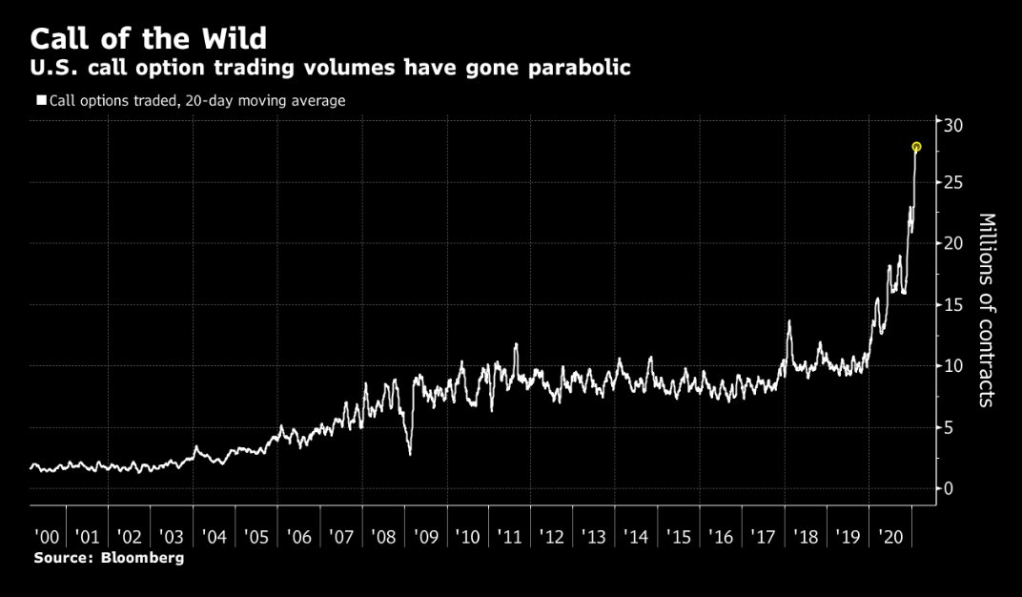
After the introduction of transaction-free brokers, such as Robinhood, the number of options traded skyrocketed.

Another GameStop is unlikely, but the increase of speculative investing by small retail accounts will fundamentally change the trading behavior of some stocks. About a year ago, WallStreetBets pushed the stock of Lumber Liquidators through community action. The Lumber Liquidators example is more representative of the market power of the WallStreeBets community. I anticipate more of those stories as the platform grows and barriers to trading are removed through applications such as Robinhood.

If it’s unlikely to happen often, why should I expect regulatory action?

Regulators are receiving pressure from institutions and retail investors to prevent similar situations from happening. On the institutional side, the demand for regulation includes a crackdown on these forums to prevent coordination on certain stock strategies. Institutions calling for greater regulation of social media coordination point to the behavior as a form of market manipulation. GameStop is not the only stock that had a semi-coordinate strategy. The WallStreetBets community tried, to a lesser extent, to exert the same pressure on AMC, Nokia, and BlackBerry.

Retail investors are arguing for regulation that would further democratize the stock market. The nature of these regulations would be to open the number of investment vehicles available for retail investors, to protect trading chat rooms (CNBC is allowed to exist, how is a Reddit forum discussing stocks fundamentally different), prevent clearinghouses from being able to raise collateral requirements in a manner that restricts retail trading.

Although the nature of the regulation that will be introduced is unclear, it’s reasonable to expect a regulatory response. Treasury Secretary Yellen scheduled meetings with the SEC, the Federal Reserve Board, the New York Fed and the Commodities Futures Trading Commission to discuss the recent events in the market. Given the Tweets above, members of Congress are interested in proposing regulation as well. The CEOs of Robinhood and Reddit will testify this month before a House Committee.

Our regulatory system does a lot in the name of “protection” to keep people of low means away from the kinds of investments that wealthy people can access. I think it is likely that the majority of the regulation that comes from the GameStop hearings will attempt to limit “risky” retail behavior, rather than open the market further. I anticipate at least some of the following regulations will be put into place:

  • Small-broker applications will be reclassified as gambling applications and regulated in the same manner as sportsbooks (state-level)
  • Small-broker applications will need to change their user interface to reduce gamification of stock trading
  • Create minimum equity requirements on trading accounts that are able to trade derivatives
  • Create a framework for the SEC to hold forums accountable for any coordination on stocks that occurs on the platform

Although the GameStop story received a lot of press, its impact on the stock market and financial institutions of the United States was marginal. Any of the likely regulations above would almost certainly do more harm than was created by the GameStop short squeeze.

I want to know more, what else can I read:

*Addendum–The relationship between broker applications and organization that purchase order flow was not addressed at all in this write-up. The example commonly found in the news is a relationship between Citadel and Robinhood. I intentionally left it out because it is not unique to the GameStop scenario, nor does it related to the underlying activity; however, I see these relationships as an area fertile for proposed regulation.

Business, Innovation, Prediction

________ As-A-Service–The New Economic Indicator

Economists are constantly inventing new weighing mechanisms to evaluate the overall health of the economy. Because the US economy is a massive, ever-changing, complex system comprised of independent and semidependent actors, no single number or equation has sufficed to gauge the heath of the economy.

I will not present a grand unifying economic theory.

Economists track a number of economic indicators to determine the health of the economy. Some indicators are leading, meaning they predict changes in the greater economy. Others are trailing, meaning they measure factors of the economy that already occurred. Given the complexity and velocity of the macro-economy, it operates with a sort of Heisenberg uncertainty principle that prevents a truly current understanding of economic health.

One of the most important leading economic indicators that policy makers use is the Consumer Confidence Index (CCI). The Consumer Confidence Index tracks responses to a monthly survey sent to consumers about their perceptions for business, employment, and income for the next six-months. Currently, the model indicates that the US is at lower-than-average confidence; however, I have reason to doubt the results.

Allow me to propose one more model for consideration. The percentage of “_________ as a Service” sales compared to total sales for the following industries:

  • Tech (enterprise, personal, and public sector)
  • Food
  • Automotive (leases)
  • Consumer non-durables

“_______ as a Service” or XaaS describes a model where consumers purchase a subscription for a product, rather than the product itself. In these agreements, the consumer pays a regular payment in exchange for usage of the product and the necessary support to maintain the product. At the end of the agreement, the consumer has no right to the product and must purchase a new subscription to continue use. Automotive leases are an example of cars as a service: consumers pay a lease to use the car each month and for the dealership to handle maintenance through the lease period.

Purchasing anything as a service requires confidence in an ability to pay for the product through and after the subscription term. If I anticipate a huge pay cut in three years, I will not start a lease. Instead, I’ll purchase a less expensive vehicle (finance if needed) that I will retain after my payments are through. Similarly, I’d purchase Microsoft Office (perpetual license), over Microsoft 365 for my personal or business use, if I had concerns about future cash flow.

Providing products as a service requires confidence from suppliers as well. If I anticipate high inflation I wouldn’t sell any subscription that locks consumers into today’s prices. In a period of high inflation, I either want to make one-time sales today or To continue the car lease example:

A dealership anticipates a 10% inflation rate over the next year. In real terms, that means that a $200/month lease today is worth $180 monthly in one year*. As a result, the dealership will encourage its sales staff to push sales over leases, or to encourage customers to wait and purchase the vehicle at a later time (because the car will sell for more nominal dollars). The lease option will lock the dealership into lower revenue for an inflationary period.

If the average consumer does not believe that she will be able to afford a subscription in the future, demand for subscriptions will fall. When producers anticipate that their products will be worth more in the future, they will not sell contracts at today’s prices. However, when both producers and consumers have confidence in the economy and their future income, the as a service model makes a lot of sense for both parties.

The “as a Service” model can cut costs and reduce time from purchasing to use for consumers. Reducing time to value is most applicable in a business-to-business context where new software deployments can take months, but holds true in the business-to-consumer landscape as well. Learning to cook and stocking a kitchen takes time and expense, consumers are increasingly shifting to Food-as-a-Service providers such as HelloFresh to manage the recipe creation and ingredient sourcing. HelloFresh allows consumers to have a “homecooked” meal much faster, and with less hassle, than the traditional grocery store process would have required. In the IT space, the as a service model reduces the physical overhead and resources that a consumer requires to support the product–the producer covers those costs with the subscription fee. Producers benefit from guaranteeing future recurring revenue and can reduce overhead through an economy of scale (by supporting all consumers). The “as a Service” model is so attractive to producers that Microsoft intentionally steers their consumers to the 365 subscriptions, rather than promote the purchase and subscription options.

The “as a Service model” is certainly booming. In 2018, Gartner predicted that “by 2020, all new entrants and 80% of haptoral vendors will offer subscription-based business models [in IT].” I could not find statistics to verify the accuracy of the claim, but it was directionally correct, at minimum. The growth rate of Microsoft 365 supports the claim.

Although the Consumer Confidence Index remains lower than historical average, the rise in XaaS agreements tells a contrary story. When confidence in both the economy and individual future purchasing power are high, XaaS arrangements are mutually beneficial. I anticipate that a reduction in the Xaas industry will be a leading indicator of falling economic confidence or a rise in inflation–both important economic indicators.

*I acknowledge the relationship between inflation and future payments isn’t as simple as stated. Financing, Net Present Value, and disparate effects of inflation create a more nuanced interaction of monthly lease payment and real value.

Innovation, Prediction, Technology

Will Google and Amazon Change Grammar Rules?

Socrates criticized writing as a lesser form of communication. A tool of the forgetful to use in record keeping and trade:

[Writers] will cease to exercise memory because they rely on that which is written, calling things to remembrance no longer from within themselves, but by means of external marks.

Plato “Phaedrus”

The introduction of the printing press was not universally welcomed as a tool to make the production of the written word easier. The telegraph? Let me give you Thoreau’s take:

Our inventions are wont to be pretty toys, which distract our attention from serious things. They are but improved means to an unimproved end,… We are in great haste to construct a magnetic telegraph from Maine to Texas; but Maine and Texas, it may be, have nothing important to communicate.

Walden

The radio, telephone, and television also promised to fundamentally worsen interpersonal communication. The English language survived, mostly unscathed. Most of the high school English curriculum was written prior to 1960, and students do not struggle comprehend the English of American authors from the turn of the century.

However, the rise of the internet, specifically Amazon shopping and Google, may fundamentally change English grammar.

Without requiring formal study, native English speakers understand how to order words in a sentence. When describing an object, the descriptors generally lead the object of description. I have a red notebook. I use a large, yellow, fine-tipped, mechanical pencil. The general form of adjective placement for the English language is that adjectives precede the word they describe in the following order: Opinion; size; physical condition; shape; age; color; origin; material; purpose.

Not all languages follow this order. If I were to translate both sentences to French, they would translate literally as: I have a notebook red. I use a large mechanical pencil (mechanical pencil is a single word, so order of those words are irrelevant) yellow with a fine tip.

Most adjectives in French follow the object they describe. The same is true for Spanish and other romance languages.

Many aspects of computing follow the romance structure of object then adjective. When storing or retrieving data, programs basically write a sentence, in the form of a script, that requests information from another part of the application or database. The “computing sentence” is most efficient and clearest when adjectives follow the object they describe. Although this phrasing might seem complex, let me introduce a familiar scenario.

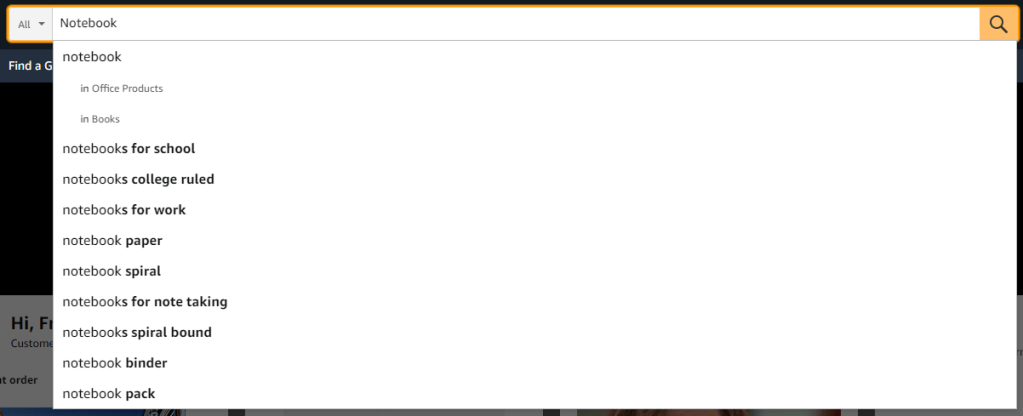
When shopping for a red notebook on Amazon, I can either search for “Red Notebook” or “Notebook Red.” Both will take me to a shopping page full of red notebooks. In the search process; however Amazon takes a different route to find those notebooks.

When I look for a red notebook, Amazon starts by looking for red items.
When the search starts with Notebook, Amazon will gather all notebooks as a starting point.

In this small search, the order doesn’t matter too much. Amazon has a powerful search engine and will react quickly to each new word. However, the path to the right notebook is more efficient when starting with notebook as my search term. When I type notebook first, Amazon recommends related searches and will limit suggestions to items related to notebooks. When I start with the word red, Amazon has to guess the next word based on the universe of items that could be red.

This image is obviously not to scale; however, if I were given the option to search either bubble for red notebooks, I’d want to start with all notebooks.

Computers are most efficient when objects are followed by descriptors. English speakers may find it more efficient to follow objects with descriptors in their internet search as well.

To revisit the red notebook example: When I search for a red notebook on Amazon, I’m given over 2000 results. Some are large, some are lined, some are bright, some belong with red fish, some with blue fish, some with one fish, some with two fish. To narrow my search, I add subsequent descriptors to my search. When I start with “red notebook,” I’ll likely end up with “red notebook hardcover lined 9×13” before finding few enough options to manually review. “Red notebook hardcover lined 9×13” does not follow any English grammar rules, and its uncomfortable to type. Amazon recommends additional words after my search, I end up with the unwieldy search by continuing to click the best fitting recommendations after each subsequent search. When I start with red notebook, Amazon recommends hardcover or paperback. I click hardcover. Still too many responses, I add a space to my search. Amazon recommends sizes. I click on the size. Too many responses. Etc.

Google works this way as well. When I search for something online and find too many results, I add additional criteria. That exercise of searching for an item and adding criteria with each subsequent search, is ultimately the same structure that Romance languages use in normal speech.

The advent of new technologies has certainly changed the English language. We have words to describe moving pictures, the internet, computer programming, and yellow fine-tipped mechanical pencils. However, these changes have been marginal. The internet, TV, and radio each added or standardized or added thousands of words, but the basic structure remained in tact. To call back to the beginning of the post, English teachers love to force Victorian literature on their students.

If the internet causes a single foundational, lasting change on the language, I think it will be a gradual shift in adjective order. Adjectives after the objects they describe are more efficient for the computer, more intuitive for online search, and are the norm for many other languages speakers that frequently use new technology. If English speakers continue to use online search for the next fifty years, and more people use voice recognition search, would it be crazy to think that the adjective order of the language will shift?