Legal, Observations, Prediction

An Inflection Point: How to Heal the Wound

I planned to write and publish this post on November 3; but wanted to respect the political climate that surrounded the election and wait until America was certain. From the start of the day, I listened to coverage of the vote turnout and it was clear that Biden was going to be president of the United States on January 20, 2021.

It is easy on November 8, to claim that it was obvious that Biden would be the winner of the election. based on news from November 3. But I contend that it was obvious.

On the morning of November 3, FiveThirtyEight modeled an 89% chance of a Biden win. 89% is not 100%, but it would require shockingly low turnout on election day or a last minute shock to be considered a likely outcome. As an exercise, FiveThirtyEight ran a simulation on November 2 where they recreated the polling error from 2016 and determined who would win the election. In that scenario, Biden won. FiveThirtyEight took the simulation further and awarded the electors from the next two likely states to Trump. In that scenario, Biden narrowly won the presidency.

Not all pollsters forecasted the same outcome as FiveThirtyEight, and I understand that not everybody follows the same news; however, FiveThirtyEight is a modeling institution that considers all mainstream pollsters in their forecast, weighted by historical accuracy. I’m using FiveThirtyEight as a proxy for an average historically-accurate forecast.

Looking at the news on November 3, it was clear to all that the United States was on pace for record voter turnout. Increased turnout has favored the Democratic party over the last few decades. Republicans win mid-terms, largely as a result of smaller turnout.

But the news the night of November 3 conflicted with the observations above. Trump was leading in many states early in the night that he would ultimately lose to Biden. The New York Times identified Michigan as a state that would likely go to Trump during the coverage (Biden ended up winning it by > 150,000 votes).

The reason for the misleading and dramatic counting of the election is twofold:

Instead, news organizations sparked increased concern about the election. Most mainstream media organizations spend election night sowing discontent by expressing their hope that Biden won the election and outlining how Trump might have won. While far-right organizations decried “late surge” of ballot counts for Biden as fraudulent. I will not post a link to that type of reporting; it does not deserve increased attention.

News organizations spent the night forecasting something that happened in the past (voting) and expressing their hope that Trump did not pull off another “miracle.” As an example of news organizations displaying partisan leanings, noted Democrat, George Stephanopoulos moderated ABC News’s bipartisan election coverage; at more than one occasion during the night he asked to see more blue (democratic wins) on the map.

He would see more blue; as soon as the mail-in ballots were counted. These organizations that spent days forecasting an event that previously occurred remind me of a scene from Mean Girls. We, as a nation should have taken them as seriously:

To this point, I’ve been pretty critical of the news (although I’ve stopped short of calling it F**e N**s). It comes with good reason. The national push to replace president Trump added to the polarization of the country. News diversity shrunk from 2016-2020 meaning that more news focused on the most polarizing issue: Trump’s presidency.

Traditional news organizations did more to gain trust with liberal-leaning readers than conservatives in 2020. Some may think that is a positive considering the propensity of the Republican president to lie. But liberals do not have a monopoly on the truth; Trump lies frequently, but his critics are not always honest.

Glenn Greenwald recently published an article about a story that was spiked by his editors at The Intercept. The article covered concerns that Hunter Biden leveraged his father’s position to secure lucrative positions with foreign governments and firms. The article falls short of accusing president-elect Biden of personally profiting or advocating policies that would aid the institutions that sponsor Hunter; but clearly and accurately identifies the open questions about the president-elect’s involvement. Greenwald alleges that the article was killed because it was too critical of president-elect Biden.

Similarly, The New York Times refused to publish Op-Eds that were deemed insensitive or objectionable more than once this year. These internal clashes on what should be published made national news.

Preventing the publication of an opinion is not censorship, nor is it a restriction of free speech. News organizations are corporations and are not required to give all writers an equal platform.

However, when mainstream media organizations make consistent editorial decisions that amplifies criticism of one party and restricts criticism of another, it fails the responsibility that it holds as the Fourth Estate. Mainstream media can no longer be an democracy maintaining institution; it becomes another source of division.

The two examples above are not outliers. The mainstream media overwhelmingly favored policies and politicians supported by Democrats.

2020 may prove to be a significant inflection point in American politics. As the level of political polarization in the United States reaches record levels, Joe Biden continues to state his desire to be a president for all Americans: “I don’t see blue or red states, but United States.”

Its time for the mainstream news to do the same. Media bias will always exist, and I am not asking for the solution for general bias. What I ask is that news organizations from Fox News to MSNBC recognize that the election is over and that the 2020 political ratings bump should not be sustained in 2021. Both sides must be willing to praise and criticize president Biden in 2021.

President Biden will not be able to be the president of all Americans, if all Americans live in a news echo chamber. In that world, only the most extreme news organizations will prosper and Biden’s message will be irrelevant.

Legal, Observations, Prediction

A Defense of the Electoral College

Everybody hates the Electoral College. Vox claims to have found the ‘Definitive Case against the Electoral College‘. The institution is undemocratic. Five times, the Electoral College prevented the candidate who won the popular vote from ascending to the presidency.

Nate Silver’s presidential forecast estimates a greater than 10% chance of Donald Trump losing the popular vote for a second time, but winning the election over Joe Biden. In fact, a scenario where Biden wins the popular vote by 2-3%, Trump is favored to win the election. The Electoral College may, for the second consecutive election, award the presidency to a candidate who did not win the popular vote.

Attacks on the Electoral College traditionally fall into one of a few categories:

  • The Electoral College is an antidemocratic institution
  • The Electoral College favors Republicans and enables a form of Gerrymandering
  • The Electoral College disenfranchises all but the “battleground states”

There is an obvious element of truth to each claim (at least when applied to recent elections). However, none are compelling enough to warrant abolishing the institution.

The Electoral College is a body of 538 electors who directly elect the president of the United States. Each state, and the District of Columbia, are awarded an allocation of voters based on population recorded in the last Census. The allocation of voters for the 2020 election are based on the 2010 Census, the allocation of voters for the 2024 election will be based on the 2020 Census. A candidate must win a majority of votes from the College to win the presidency. If no candidate wins a majority, the Congress will choose the president and vice-president.

Too often, the word democracy is used as a value positive term. When we say something is “democratic” we mean to say that it is just; conversely, when we label something as “antidemocratic”, we mean to say that it is corrupt or communist. The critique that the Electoral College is antidemocratic, is not a critique, its a fact. It, like the Senate or Supreme Court, was designed to protect the country from direct democracy. The political parties of our founding fathers were Federalists and Democratic-Republicans, not Direct-Democrats:

The second and third common critiques of the Electoral College center on disenfranchisement and the value of a single vote. It is true that the Electoral College values individual votes differently. A single Electoral College vote in Washington DC contains half as many citizens as a single vote in Texas. This means that each Texas voter is half as important as a voter in Washington DC (Wyoming/California has the widest gap).

However, the inequality of Electoral College simply mirrors that of Congress (1 voter per Senator/Representative) and I don’t hear the same concerns with Congressional allocation. Surely, there is something worse than the Electoral College vote allocation that causes the level of disenfranchisement in US presidential elections. Or is it that the Electoral College always benefits one party? In the case above, I presented a scenario that generally benefits Democratic candidates (D.C is blue and Texas is generally red) over their Republican opposition. Because the elector allocation is based off of Census population, the bias changes over time. In ’92, ’96 and ’04 the Electoral College favored the Democratic candidate.

The Electoral College only determines how votes are allocated and the process for directly electing the president. States determine how elections are conducted by their populations. Currently, 48 of 50 states and the District of Columbia require that all Electoral College votes go to the candidate that won the state or act as a “faithless Elector” (where allowed).

If 3 million people vote for the Republican candidate in Pennsylvania and 2.9 million vote for the Democratic candidate, the Republican wins 20 votes and the Democrat wins 0. The Electoral College, as an institution, does not create this outcome, the state of Pennsylvania does. When only Maine and Nebraska allow for split votes, voting for the US president begins to feel like an exercise in futility.

Abolishing the Electoral College and moving to a national popular vote would resolve the problems in the winner-take-all nature of presidential elections, the national popular vote loses some of the Electoral College benefits. Additionally, abolishing the Electoral College isn’t politically viable.

Abolishing the Electoral College requires an amendment to the Constitution that both abolishes the institution and sets a new standard for electing the US president. The last amendment added to the Constitution, a single line preventing Congress from passing their own pay increase, was ratified in 1992. Nothing has been ratified in the 25+ years since.

A policy compromise is in order. The state legislatures should form a pact to abolish their own winner-take-all rules. Asking the states to undo these laws is not unprecedented, nor is it naïve. Sixteen states, and the District of Columbia have already signed a compact to award their Electoral College votes to the winner of the national popular vote, once the compact has over 270 votes in its constituency. If 36% of the Electoral Votes are already pledged to this contract (which violates the promise of both the Electoral College and local elections), it is not unthinkable that 50% of entities would agree to abolish their winner-take-all elections.

I’ve labelled this post “A defense of the Electoral College,” and so far have not defended it. The Electoral College is an institution, like many in the US government, designed to protect smaller interests and add efficiency to an inefficient process. Allow me to provide a few scenarios where the Electoral College is beneficial:

  • The candidate who wins the popular vote falls ill, or dies, between the election and inauguration.
  • The candidate who wins the popular vote falls victim to scandal that leaves her unfit for the office of the presidency
  • Election tampering or voting error in one state prevents the national election from being able to record the popular vote in that state through November.

None of these cases are particularly far-fetched. Especially when looking at an election rife with scandal of two septuagenarians. The Electoral College’s 538 voters are able to vote closer to the inauguration (because their votes can be easily counted and they cannot be tampered with) and react to critical changes without looking to millions of people (where allowed by their state). If one state cannot determine the popular vote (cough…..cough Florida), the Electoral College can still elect a president.

In a typical election the Electoral College helps protect diverse interests. Often this is phased as the Electoral College bolsters small states at the expense of larger ones. I content that the more densely populated an area, the more similar their needs from a national government. The Electoral College overvalues areas with sparse populations (with the exception of DC) who have more individualistic needs of a national government in terms of infrastructure, educational policy, financial incentives, environmental policy). While a few cities would not control the national popular vote, states such as Wyoming, Montana, Hawaii, and Alaska who have diverse needs, would be irrelevant.

The president has unilateral authority in certain arenas. To prevent Congress from being dominated by a minority of states, the Constitution awards Senate votes equally. Why should the president, who also has some unilateral governing authority, be exempt from the same voting concerns?

Fashion, Observations, Prediction

Rococo Style and My Enlightenment

I hate Rococo design. I doubt that’s a controversial opinion, I don’t see many modern homes with cherubs or flower designs on pastel walls. Rococo furniture is a far cry from the Midcentury Modern pieces that have been prized for the last 5 years.

Would this work in your entryway?

When I was a college student, I had the good fortune to study abroad in France and visit Versailles. Parts of the palace are gorgeous, and its easy to see how impressive the furniture, construction, and vastness of the property are under the museum lights. During my first tour, I was unimpressed by the Hall of Mirrors. I expected to be awed by the light and opulence. It really didn’t stand out from the rest of the Baroque architecture throughout the palace.

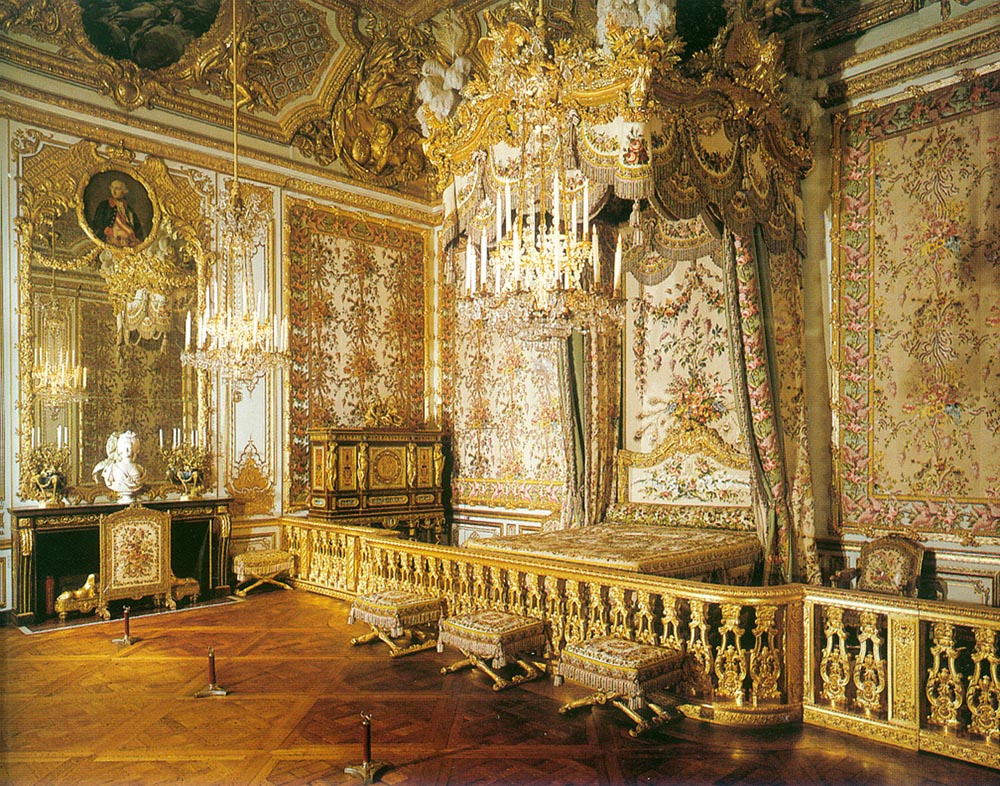
The Queen’s Bedchamber, on the other hand, was impossible to miss. It was easily as bright as the hall of mirrors, but instead of having stone columns to contrast the gold, the Queen’s Bedchamber used flower motifs, pink and more gold.

Subtle.

If you have a home VR set up, you can see the the rooms described above for free at the official Versailles website.

Even after my initial experience of Versailles (and other Rococo experiences), I remain justified in my experience with Versailles. But my experience with the grounds differed in myriad ways from the experience of those in the 18th century. One key difference was how the space was lit.

With museum lighting in every room, it isn’t shocking that I wasn’t impressed by the brightness and glimmer of the Hall of Mirrors. The sun coming through the windows and bouncing off the mirrors and gold is no brighter than museum lighting at 3700K (more on this later) that flooded every room. If I toured a building lit only by small translucent windows and whale fat or beeswax, I would have found the Hall of Mirrors to be an incredible open space.

Rococo décor brought whimsy and light to otherwise dark rooms. Baroque design, while similar, lev . Rococo is an attempt to heighten both the brightness of the room and create smaller, more intimate spaces.

Maybe we need a form of Rococo revival today.

Earlier this year, I made predictions about the state of interior design in 2030. One of those predictions involved a shift away from the open-concept floorplan with Bobby Blue and Grey. Smaller rooms will provide an opportunity to deliberately use light as a key design element in a way that isn’t possible in open spaces. The vast majority of lights sold and stocked by Home Depot are soft white (2700K). When a vast space requires overhead lighting, the lighting needs to be neutral and consistent. Lamps are able to add contrast or accent a space, but the lighting is defined by the room in its entirety.

Light temperature is measured in Kalvin. By comparison to soft white, the candles in Versailles burned around 1800K. The lower the Kalvin value, the warmer the light.

Color Temperature Scale

In the modern Rococo revolution, I envision smaller comfortable spaces with varied light used to create different atmospheres. Dining rooms lit low with warm light (~2000k). Kitchens and bathrooms with daylight bulbs that prioritize accuracy (~5000k). Entryways and foyers lit in between to smooth transitions between spaces. I don’t envision cherubs, or flowers as normal wall coverings. I still hate Rococo.

Light alters our perception of space, mentality, and design options. Hopefully my prediction for the next 10 years proves true. Maybe I won’t hate the next Rococo revival.

Education, Observations, Prediction, Technology, words words words

What Cooking Taught Me About Online Education

I aspire to be a moderately successful home cook. I have a few specialties and can cobble together a decent meal each night, but I clearly lack fundamental skills. My vegetables, rice and pasta look rustic at best. I dedicated the last weekend to improving all three. My goal was to create one batch of sticky rice and one plate of pasta that passed muster.

Did I do it? You should know that if a blog describes cooking, you’ll have to endure a novel before you are permitted to see the results.

I’ve read a number of cookbooks, watched Masterclasses, and YouTube videos to improve my technique. I found some to be incredibly helpful, Jacque Pepin’s knife skills are a perfect primer. Joshua Weissman offers a good series on how to cook at home. But after a weekend of practice, I learned as much about remote education as I did about cooking.

Students have a number of learning styles. Schools attempt to incorporate a multitude of learning styles in their instruction. The VARK model is a widely-used schema for cataloging learning preference that educators use to vary instruction. In the VARK model, there are four types of learners:

  • Visual–learners that best internalize and synthesize graphic information such as charts, diagrams, hierarchies.
  • Auditory–learners who succeed when they have the opportunity to listen and wrestle with concepts verbally.
  • Reading–These are good students (I kid). Reading/writing learners are best when given the opportunity to read and write about their subject matter.
  • Kinesthetic–For these students, learning is a physically active endeavor.

One can argue how well the public school system caters to each style, if the VARK model is an appropriate way to classify learning styles, or if learning styles exist. However, when I was attempting to better my cooking this weekend, it was clear that all of the learning styles referenced above were available to me. I listened to and watched videos (Visual/Auditory). I rolled dough, and rolled dough, and rolled some more (kinesthetic). I read recipes and descriptions (Visual). I’ve considered myself a visual-spatial learner, and had no problem learning through the combination of media available to me. On-line education upheld its promise.

Yet, something was missing in my culinary lessons. I wasn’t always improving batch-to-batch. Learning models frequently focus on how to plan lessons and engage students, but rarely outline the best way to curb bad outcomes or patterns. I intuitively know that I wouldn’t benefit as much from a golf lesson over Zoom, as I would in person. My swing needs physical correction and don’t have the spatial awareness necessary to correct from words alone. Similarly, I wouldn’t want to take a music lesson without an instructor present to help correct breathing, posture and adjust my movements in real-time.

After a weekend, I made incremental improvement in my ability to roll pasta and cut noodles, make sushi rice, and consistently cut a range of vegetables. I would have improved faster if I received real-time physical corrections. Practice does not make perfect, practice makes permanent. Without immediate correction, I’ve further entrenched bad habits that I hope to learn enough to correct later. When learning to cook online, I learned my personal limit with the available media.

Not perfect, but an improvement over past attempts.

Many students will return to academia online this coming semester. Invariably, these students will miss out on a number of intangible benefits of traditional education. In addition, I worry that these students will miss out on having their bad outcomes or patterns corrected. Will it be as easy to foster challenging intellectual conversation over the Web? Will educators be able to help students course correct in any academic discipline in video lessons?

Remote pedagogy might be the best course of action for many this autumn. That is not a topic I want to engage. However, I predict that remote learning will benefit the students of math, technology, and the sciences. I won’t be surprised when it results in poor outcomes in philosophy, history, language and elective courses. I won’t be surprised when remote learning constraints are further used to reduce funding of the Arts. Remote learning is probably not suited for disciplines of nuance that require gentle but constant and immediate corrections from an engaged educator.

Legal, Observations, Prediction

What to expect for the 2020 election?

On July 30, President Donald Trump recommended delaying the national presidential election due to the COVID-19 pandemic until citizens would be able to vote “properly, securely, and safely.” Senate Majority Leader Mitch McConnell quickly confirmed that the election will occur on November 3 and that the power to delay elections is a legislative power.

Given the current pollical climate and severity of the COVID-19 pandemic, November 3, 2020 will not proceed as smoothly as it did in 2016 or 2012. What follows is my analysis of the challenges, threats, and opportunities of the 2020 presidential election.

What would happen if Congress delays the election?

If Congress were to delay the election far enough that the results could not be certified by January 6, the Presidency (and Vice Presidency) will still end on January 20. This date cannot be changed, as it would require a Constitutional amendment. If the election has not been certified by the 6th, a few others may be eligible to step in as interim (including Nancy Pelosi).

If the election were delayed a few days, but all necessary parties are able to certify the results by January 6, then a delay may become feasible. Provided, that the United States has a president ready to take over on January 20, any election delay will not disrupt the political system.

What about a universal mail-in ballot option?

34 states already allow absentee voting without providing a reason and there is bipartisan support for an expansion of absentee voting nationwide due to COVID. Practically, absentee voting without excuse (or using COVID as an excuse) is the same as a universal option for mail-in voting. Some states plan to go farther by proactively sending mail-in ballots to all registered voters.

Critics contend that voting-by-mail is more susceptible to voting fraud. There is little reason to believe mail-in votes are more likely to be fraudulent. By example, the Heritage Foundation found only 14 cases of attempted mail fraud out of roughly 15.5 million ballots cast in Oregon since that state started conducting elections by mail in 1998.

Why not conduct voting online?

This is not a good idea. I cannot stress this enough. Unlike voting by mail, online voting loses the physical record and is rife with cybersecurity concerns. Because I don’t have credibility on the software development process, I’ll leave this one to the experts:

Via XKCD
Tom Scott explains the concerns well. Highly recommend his channel.

Is normal, in-person voting possible?

Absolutely. Many Americans will vote in person this November. However, voting “normally” might not be as easy as it has been in past elections. In April, the state of Wisconsin ran state elections during the COVID pandemic. Milwaukee, which normally hosts 180 polling locations, had only five open during the election. Polling locations were limited due to a limited number of available workers and locations suited to social distancing. As a result, voter turnout depressed.

So what do I think should happen?

The President’s term will end January 20. That date will not, and should not, change. Congress must certify the results of the election on January 6, I would not change that date either to account for any legal or procedural challenges to the results. Congress should extend the voting window past November 3 for remote voting with a law that supersedes state election laws. States should be given the mandate to keep voting booths open from 8am-8pm minimum, and not close until all who arrived had the chance to vote in a socially-distanced atmosphere (even if that requires keeping polling locations open into the 4th). Additionally, polling locations should reserve a portion of booths for appointment-only voting for those who are in high-risk populations for COVID-19. Those that make it to a pooling location but are unable to vote at the time due to COVID fears or a need to leave before a location is ready, should be given a ballot that can be sent by mail until the 5th.

All states should be required to provide a universal mail-in ballot option. If absentee voting receives bi-partisan support, voting by mail should as well. I doubt that 2020 will set a record for high voter turnout as a percentage of the available population; federal and state governments must making voting as easy and safe as possible.

The key to this approach is to retain as much of the physical voting record as possible. The obvious risk to allowing a longer window for mail-in and in-person voting is that polling stations will receive duplicate ballots. The Federal Government should allocate the funds and resources necessary to allow states to identify and process duplicate ballots correctly. This would be a wise use of funding. States should not be allowed to disclose any results until a pre-determined date when all ballots have been submitted.