words words words

A Few Dream Interviews

In my last post, I described the desire to watch (or listen to) an interview between Dick Cavett and Dr. Atul Gawande. As an exercise, I wanted to see if it would make my list of interviews that will never happen but I would love to hear.

To set some parameters for list design:

  • Each interview must have, at least, one person who generally interviews others and have no more than 2 parties.
    • The conversation does not need to be strictly host and guest format, but having an interviewer and interviewee helps set structure.
    • Bands, groups, and teams could comprise a single party.
  • I must be reasonably sure that both parties are interesting in conversation, not just interesting people.
    • Jeff Bezos, Tim Cook, Elon Musk, are examples that fall into this category for me.
  • The interview should not be political in nature.
    • e.g. the Trumps, Obamas, Bidens, Clintons, and Condoleezza Rice are excluded.
  • I must be reasonably sure that the interview will never happen.
    • Joe Rogan and Oprah are excluded from being interviewers because they are likely willing and able to interview anyone.
  • All parties must be living, physically capable of conversation, and speak the same language.

With the constraints in mind, the proposed conversation between Atul Gawande and Dick Cavett certainly makes my list. Here are a few others that did as well:

Tyler Cowen interviewing John Green:

  • Who are they?
  • Why would it be interesting?
    • Tyler Cowen’s signature interview segment is “overrated or underrated,” where he asks his interviewees wither a series of concepts or items are over- or underrated. John Green’s podcast, the Anthropocene Reviewed, rates aspects of the human experience.
    • Tyler Cowen has an incredibly adversarial interview style, John Green is very sentimental. Both are well versed in a wide range of subjects. I imagine that the conversation will center on reviews of their shared experiences, from opposite vantage points and approaches.
  • Why wont it happen?
    • Tyler Cowen tends to interview titans with strongly held beliefs in the technology, economics, progress-studies fields. John Green is not in any of them, and I am not sure that the interview would benefit either professionally.

Pardon My Take interviewing Sheryl Sandberg:

  • Who are they?
    • Sheryl Sandberg is the Chief Operating Officer of Facebook and founder of LeanIn.org.
    • Pardon My Take (PMT) is the team, of Dan Katz and PFT Commenter, that produces an eponymous sports/satire podcast for Barstool Sports.
  • Why would it be interesting?
    • Sheryl Sandberg is an inspiration for young leaders, specifically women, and for those grieving. She frequently speaks to women’s forums, elite institutions of higher learning, and writes for educated audiences. Pardon My Take has the most popular sports podcast and, almost exclusively, engages with the 18-35 male demographic. In order to confront toxic masculinity in the workplace, Sandberg’s message needs to meet that audience where it is comfortable.
    • Pardon My Take tends to make comedy for young men that are interested in sports. The hosts generally keep the conversation light, but are capable of serious topics (they had Dr. Fauci on to stress the importance of safe practices during COVID) and understand when to joke and when to let a guest speak. More than other platforms that target young men, these hosts are willing expand the horizon of their show (they did a series on Dungeons and Dragons) beyond what their audience thinks will be “cool.”
  • Why wont it happen?
    • I could not find a video where Sandberg engaged with popular culture and cannot imagine her sitting for jokes at Barstool sports.

Ross Douthat interviews Christopher Moore:

  • Who are they?
    • Christopher Moore is a comedic author.
    • Ross Douthat is a blogger, author, columnist, and conservative political analyst with a strong focus on religion.
  • Why would it be interesting?
    • I imagine the conversation would start with Moore’s Lamb and how to think about Christ’s story. From that launching point, the conversation may meander to colors, progress studies, the need for religion, or the human condition. I would love to hear the conversation progress. Douthat’s most recent book The Decadent Society argues that the West is now in a decadent phase, the phase that commonly precedes catastrophe. Would Moore agree?
  • Why wont it happen?
    • Neither Moore nor Douthat appear to seek popular interview channels. I don’t know that most Moore readers also read Douthat and vice versa.

Other notable proposed interviews:

Melissa Murray interviewing Tom Scott, Mike Duncan interviewing Jeffrey Morgenthaler, Tim Ferris interviewing James May (too likely?), and Malcolm Gladwell interviewing Dan Harmon (too likely?).

Observations, words words words

A law: tag, and u. Catch it, rare VD.

Dr. Atul Gawande‘s Being Mortal is not a book that should be absorbed and placed back on the shelf. The book should be wrestled with, discussed, and lessons should be teased out. The novel calls its reader to action. Being Mortal addresses the the toughest aspect of human life. It pleads with readers to know when to act counter to their personal hopes in order to create the best outcomes for loved ones. In the novel, which addresses how to improve end of life care, Dr. Gawande admits that he was, at times, uncertain of when to change course, from treatments that maximize longevity of life, to treatments aimed at maximizing quality of life for his own father.

After reading the book, I searched for interviews with Dr. Gawande. I was hoping to hear him confront an interviewer’s questions in real time and express the emotional vulnerabilities associated with planning end of life care. Dr. Gawande does more speaking than conversing in public (although his Talks at Google performance is worth watching). I couldn’t find an interview that met my desire.

Dick Cavett is 83. From ’68-’74, he led the best late night interview show on tv. I’ll occasionally watch his interviews as reruns or on YouTube. Cavett’s interviews are a window into personal thoughts of the titans of the era. I will never experience the culture the brought Woodstock, the Beatles, or the Vietnam protests. I can watch recordings of Hendrix, but I’ll learn more about the moment by watching Cavett than watching the concert. He has a relaxed conversational style that allows his guests to control the subject matter, but a wit and persistence that brings most conversations to a vulnerable place (with the obvious exception of Peter Falk).

Dick Cavett remains active. Early this year, he had an interview with Stephen Colbert. At 83, he appears to be in good shape both mentally, and physically. Over the last 30 years, Cavett has publicly addressed depression and his personal struggles. He is an advocate for seeking help and willing to be vulnerable about his experiences. In a 2014 Psychology Today interview Cavett describes his first experiences with depression:

Serani: So your first intervention for depression didn’t really go very well.

Cavett: (Laughs) I guess that was my first intervention. Yeah, I think I didn’t get what was really happening to me then and the woman there certainly didn’t either. There were two major episodes of depression that came later in my life. And, oh, it was so baffling. You know when you have the flu and you can’t remember when you felt well? And then when you feel better, you can barely remember feeling sick? The authority of depression is horrifying. I felt like my brain was busted and that I could never feel good again. I really thought that I was never gonna heal.

Deborah Serani Psy.D. interviewing Dick Cavett

When looking for an interview with Dr. Gawande, I was looking for an interview between someone like Cavett and Dr. Gawande. I was hoping to find Dr. Gawande speaking to a vulnerable, but brilliant, elderly person in an unstructured environment. I was hoping to find an interview that works for all ages and doesn’t feel like a lecture. Cavett, I’m sure, would openly discuss his personal experiences and challenge Dr. Gawande’s directives where one might expect that an elderly loved one would. Although, I’ll never see it, Dick Cavett interviewing Dr. Atul Gawande is what I was searching for.

Dick Cavett has a terrible hobby of anagramming other people’s names. The title was an homage to that practice.

Observations, words words words

Article Review: The Truth is Paywalled But The Lies Are Free

Good headline, no? I saw the headline scrolling Reddit and had to read the article (albeit a week or two later). The headline was so good, I found myself referencing the article before I read the content. “The Truth is Paywalled, But the Lies Are Free.”

Let it sink in.

The truth is paywalled, but the lies are free. It’s intuitively true and validated daily. Too often, I see a Google news alert with an urgent headline such as “Tokyo Now Has Transparent Public Toilets. Let Us Explain” but when I try to learn more and become an informed citizen, I’m blocked by a paywall.

The article didn’t live up to the title. At the beginning of the article, the author makes a few excellent points related to online articles:

  • Journalism and research are expensive to do well
  • Fabrication and plagiarism cost very little to produce
  • The compensation structure of production benefits those that can produce quickly and spur engagement

Unfortunately the author uses those points, which merit discussion, as a springboard to propose a world with perfect information through a free-to-access online Utopia:

In fact, to see just how much human potential is being squandered by having knowledge dispensed by the “free market,” let us briefly picture what “totally democratic and accessible knowledge” would look like. Let’s imagine that instead of having to use privatized research services like Google Scholar and EBSCO, there was a single public search database containing every newspaper article, every magazine article, every academic journal article, every court record, every government document, every website, every piece of software, every film, song, photograph, television show, and video clip, and every book in existence.

I’ll save my analysis of this utopia, it isn’t relevant to my post. In the pivot from an analysis of why it is hard for citizens to remain informed to a takedown of US copyright law and research funding, the author lost the second half of the title: The lies are free.

What a waste of a headline. The author spends one short paragraph on the impact of pervasive inaccurate news. US politics have been shaped over the last four years over which news sources are trustworthy. The President’s use of the term “fake news” has been so frequent and effective that exposure to the phrase dampens the public’s ability to discern real from fraudulent news. The author of the article that inspired this post used only conservative sources when highlighting the prevalence of lies in internet reporting.

“The truth is paywalled, but the lies are free.” In this climate, the author should use this title to help readers navigate a politicized news landscape. It’s clear to me that the Financial Times would be an excellent source of news, but I don’t have FT money. Instead I’m stuck with Financial Buzz and Forbes. Every few hours Google pushes me toward an article from an unknown guy in a van, and I’m stuck trying to determine what I can consider fact and what deserves additional scrutiny. A few tips to help readers determine which news is real after an analysis of the publishing landscape would be a perfect use of a perfect title.

I have a few tips that I’ve found to help me determine if I can trust what I am reading:

  • Biased news is not necessarily inaccurate news
  • If the story comes from a reputable news source, it is probably factually correct to a large extent.
    • A story from an unknown news source is not necessarily less trustworthy, but should be validated with other sources.
  • If the site does not differentiate news and editorial/opinion pieces, I should verify the facts with a different, credible source.
  • If the article does not include a byline, and the source is not traditionally respected (e.g. The Economist) I should verify the facts with a different, credible source.
  • The harder a story is to find, the more I should doubt its accuracy
    • This point is relatively controversial due to the politicized environment. The premise is that if the facts can’t be verified or if the story has not been circulated.
  • If I only have access to the headline and nut graf, I have not read enough context to judge the story in full.

I will continue to be tricked or misread articles in future. And when I am gated from a compelling story, I’m sure I will continue to use the phase “The truth is paywalled, but the lies are free.” But like a great single on a bad album, I’ll forget where I originally heard it and never recommend the rest of the work to anyone.

Fashion, Observations, Prediction

Rococo Style and My Enlightenment

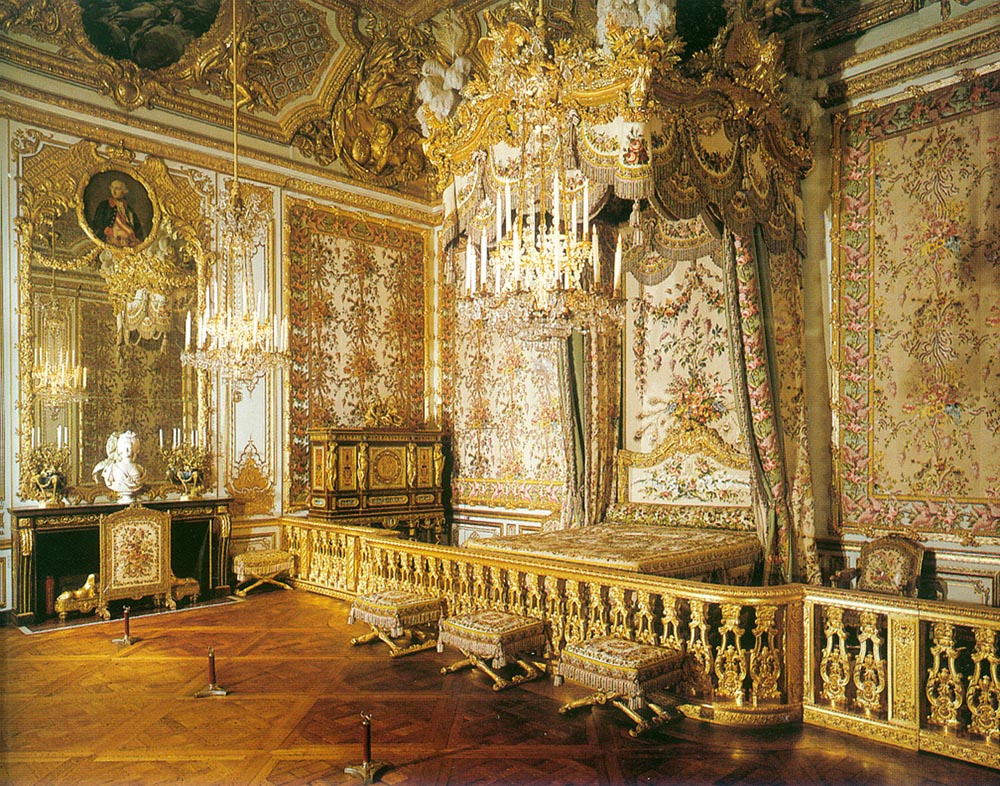
I hate Rococo design. I doubt that’s a controversial opinion, I don’t see many modern homes with cherubs or flower designs on pastel walls. Rococo furniture is a far cry from the Midcentury Modern pieces that have been prized for the last 5 years.

Would this work in your entryway?

When I was a college student, I had the good fortune to study abroad in France and visit Versailles. Parts of the palace are gorgeous, and its easy to see how impressive the furniture, construction, and vastness of the property are under the museum lights. During my first tour, I was unimpressed by the Hall of Mirrors. I expected to be awed by the light and opulence. It really didn’t stand out from the rest of the Baroque architecture throughout the palace.

The Queen’s Bedchamber, on the other hand, was impossible to miss. It was easily as bright as the hall of mirrors, but instead of having stone columns to contrast the gold, the Queen’s Bedchamber used flower motifs, pink and more gold.

Subtle.

If you have a home VR set up, you can see the the rooms described above for free at the official Versailles website.

Even after my initial experience of Versailles (and other Rococo experiences), I remain justified in my experience with Versailles. But my experience with the grounds differed in myriad ways from the experience of those in the 18th century. One key difference was how the space was lit.

With museum lighting in every room, it isn’t shocking that I wasn’t impressed by the brightness and glimmer of the Hall of Mirrors. The sun coming through the windows and bouncing off the mirrors and gold is no brighter than museum lighting at 3700K (more on this later) that flooded every room. If I toured a building lit only by small translucent windows and whale fat or beeswax, I would have found the Hall of Mirrors to be an incredible open space.

Rococo décor brought whimsy and light to otherwise dark rooms. Baroque design, while similar, lev . Rococo is an attempt to heighten both the brightness of the room and create smaller, more intimate spaces.

Maybe we need a form of Rococo revival today.

Earlier this year, I made predictions about the state of interior design in 2030. One of those predictions involved a shift away from the open-concept floorplan with Bobby Blue and Grey. Smaller rooms will provide an opportunity to deliberately use light as a key design element in a way that isn’t possible in open spaces. The vast majority of lights sold and stocked by Home Depot are soft white (2700K). When a vast space requires overhead lighting, the lighting needs to be neutral and consistent. Lamps are able to add contrast or accent a space, but the lighting is defined by the room in its entirety.

Light temperature is measured in Kalvin. By comparison to soft white, the candles in Versailles burned around 1800K. The lower the Kalvin value, the warmer the light.

Color Temperature Scale

In the modern Rococo revolution, I envision smaller comfortable spaces with varied light used to create different atmospheres. Dining rooms lit low with warm light (~2000k). Kitchens and bathrooms with daylight bulbs that prioritize accuracy (~5000k). Entryways and foyers lit in between to smooth transitions between spaces. I don’t envision cherubs, or flowers as normal wall coverings. I still hate Rococo.

Light alters our perception of space, mentality, and design options. Hopefully my prediction for the next 10 years proves true. Maybe I won’t hate the next Rococo revival.

Education, Observations, Prediction, Technology, words words words

What Cooking Taught Me About Online Education

I aspire to be a moderately successful home cook. I have a few specialties and can cobble together a decent meal each night, but I clearly lack fundamental skills. My vegetables, rice and pasta look rustic at best. I dedicated the last weekend to improving all three. My goal was to create one batch of sticky rice and one plate of pasta that passed muster.

Did I do it? You should know that if a blog describes cooking, you’ll have to endure a novel before you are permitted to see the results.

I’ve read a number of cookbooks, watched Masterclasses, and YouTube videos to improve my technique. I found some to be incredibly helpful, Jacque Pepin’s knife skills are a perfect primer. Joshua Weissman offers a good series on how to cook at home. But after a weekend of practice, I learned as much about remote education as I did about cooking.

Students have a number of learning styles. Schools attempt to incorporate a multitude of learning styles in their instruction. The VARK model is a widely-used schema for cataloging learning preference that educators use to vary instruction. In the VARK model, there are four types of learners:

  • Visual–learners that best internalize and synthesize graphic information such as charts, diagrams, hierarchies.
  • Auditory–learners who succeed when they have the opportunity to listen and wrestle with concepts verbally.
  • Reading–These are good students (I kid). Reading/writing learners are best when given the opportunity to read and write about their subject matter.
  • Kinesthetic–For these students, learning is a physically active endeavor.

One can argue how well the public school system caters to each style, if the VARK model is an appropriate way to classify learning styles, or if learning styles exist. However, when I was attempting to better my cooking this weekend, it was clear that all of the learning styles referenced above were available to me. I listened to and watched videos (Visual/Auditory). I rolled dough, and rolled dough, and rolled some more (kinesthetic). I read recipes and descriptions (Visual). I’ve considered myself a visual-spatial learner, and had no problem learning through the combination of media available to me. On-line education upheld its promise.

Yet, something was missing in my culinary lessons. I wasn’t always improving batch-to-batch. Learning models frequently focus on how to plan lessons and engage students, but rarely outline the best way to curb bad outcomes or patterns. I intuitively know that I wouldn’t benefit as much from a golf lesson over Zoom, as I would in person. My swing needs physical correction and don’t have the spatial awareness necessary to correct from words alone. Similarly, I wouldn’t want to take a music lesson without an instructor present to help correct breathing, posture and adjust my movements in real-time.

After a weekend, I made incremental improvement in my ability to roll pasta and cut noodles, make sushi rice, and consistently cut a range of vegetables. I would have improved faster if I received real-time physical corrections. Practice does not make perfect, practice makes permanent. Without immediate correction, I’ve further entrenched bad habits that I hope to learn enough to correct later. When learning to cook online, I learned my personal limit with the available media.

Not perfect, but an improvement over past attempts.

Many students will return to academia online this coming semester. Invariably, these students will miss out on a number of intangible benefits of traditional education. In addition, I worry that these students will miss out on having their bad outcomes or patterns corrected. Will it be as easy to foster challenging intellectual conversation over the Web? Will educators be able to help students course correct in any academic discipline in video lessons?

Remote pedagogy might be the best course of action for many this autumn. That is not a topic I want to engage. However, I predict that remote learning will benefit the students of math, technology, and the sciences. I won’t be surprised when it results in poor outcomes in philosophy, history, language and elective courses. I won’t be surprised when remote learning constraints are further used to reduce funding of the Arts. Remote learning is probably not suited for disciplines of nuance that require gentle but constant and immediate corrections from an engaged educator.