Legal, Politics, Prediction

No, The Republicans Aren’t Stupid…Probably

The Republican Party has been plagued with misstep after misstep. From a press conference at a landscaping firm, a top lawyer having his license suspended, to multiple impeachments and a lie about election results, the Republican party leads have appeared to have blundered its way through the last couple of years.

The press has not overlooked the frequency of these blunders; nor has it let the GOP off the hook for them. It’s easy to find articles with headlines that emphasize the Republican Party’s “disasters,” rather than report events. I’ve added one such headline below:

POLITICO Playbook: Graham: Biden made GOP look like ‘f—ing idiots’

Politico Blog 6/25/2021

Is it the case that the Republican Party elites are f—ing idiots? Or is there a reason for the series of blunders and scandals, even when the Democrats control the White House? I’d like to offer an alternative reason for many of the more obviously comical blunders of the GOP–rational and mercenary political strategy.

In 2018, GOP party outlook was bleak. Only 44% of registered voters approved of Trump, international approval was almost nonexistent, and lost ground in Congress, Gubernatorial elections and state legislatures. Republican elites tried and proved they could not control Trump’s Twitter or press conference antics. In that desolate time, a few positive trends appeared:

You’re a highly-paid political consultant to the GOP after the 2018 midterms. It’s clear that the Party cannot control Trump and dissent in the ranks will only benefit the Democrats. What plan will you provide to Party leads to strengthen the short-term outlook of the party?

Let me provide a hypothetical plan that I might have suggested, and may not be far from the truth:

  1. Limit access to voting for populations who are likely to vote “blue”
  2. Avoid introducing policy positions where possible
  3. Keep news coverage from the left dismissive and intense. Increase the amount and intensity of fearmongering from conservative news sources.
  4. Build a party by opposition.
  5. Govern from the Court.

Within this framework, the bulk of Republican party missteps start to look intentional and strategic. Before looking at some of those missteps, I’ll build a short case that each of the bullets above are part of the current Republican Party strategy.

  1. Limit access to voting for populations who are likely to vote “blue”

On July 1, 2021, Justice Sam Alito released the 6-3 majority opinion for Brnovich v. Democratic National Committee. The case evaluated whether changes to early voting laws and out of precinct ballot counting violated Section 2 of the Voting Rights Act. The facts of the case indicated that no history of fraud was associated with out-of-precinct ballots and that these changes invalidated minority ballots at twice the rate they invalidated majority voters. The majority opinion found that the state was within its rights to enact these restrictive laws because the impact to minorities was small in absolute terms and none of the restrictions imposes a burden greater than the usual burden of voting on voters. The ruling is significant because it enables states to continue to impose barriers to voting that will likely benefit Republicans.

The aim of these laws was made clear by the state’s lawyer, Michael Carvin, during oral argument:

Because it puts us at a competitive disadvantage relative to Democrats. Politics is a zero sum game. And every extra vote they get through unlawful interpretations of Section 2 hurts us. It’s the difference between winning an election 50-49 and losing an election.

Carvin describing the need for these laws

2. Avoid introducing policy positions where possible

During the 2020 Republican National Convention, the Republican Party declined to produce a party platform. The 2016 Platform was 66 pages and included party stances on cybersecurity, human trafficking, crony capitalism, healthcare, Human Rights, and Government Reform. A party platform directs the party for the next four years and informs voters of what it means to be a member of the party. Not having a platform is an aberration for a political organization.

Rather than a platform, the Republican Convention of 2020 released a statement that includes:

…The media has outrageously misrepresented the implications of the RNC not
adopting a new platform in 2020 and continues to engage in misleading advocacy for the failed policies of the Obama-Biden Administration, rather than providing the public with unbiased reporting of facts; and WHEREAS, The RNC enthusiastically supports President Trump and continues to reject the policy positions of the Obama-Biden Administration, as well as those espoused by the Democratic National Committee today; therefore, be it RESOLVED, That the Republican Party has and will continue to enthusiastically support the President’s America-first agenda.

3. Keep news coverage from the left dismissive and intense. Increase the amount and intensity of fearmongering from conservative news sources.

The headlines linked in the first paragraph are evidence that, even mainstream, news organizations are editorializing headlines. In 2016, Jim Rutenburg wrote a piece for the New York Times (gated) where he wrote, “You have to throw out the textbook [of] American journalism…. You would move closer than you’ve ever been to being oppositional. That’s uncomfortable and uncharted territory for every mainstream, non-opinion journalist… by normal standards, untenable.” Oppositional media strengthens the doubt sowed by Republican elites in the last few years. The opposition of main stream news has been a major help in isolating and insolating Republicans from thoughts or perspectives that might harm party alignment.

Similarly conservative media has focused on demonizing the liberal media and Democrats in general. Tucker, the highest rated cable news show, wins viewers with a mix of vitriolic, bombastic, and fearmongering rhetoric. It might not be fair to point to a single news outlet as the totality of conservative news, but if I were to point to a single source Tucker is by far the most emblematic. During the Trump presidency, Trump keyed into Tucker to determine where his followers were leaning and Tucker was the highest rated cable news show in history. Hard to pick a better representation of conservative media in the Trump era.

4. Build a party by opposition

I’ve established that the GOP did not produce a platform with any policy stances during the 2020 convention. In lieu of the platform, GOP produced a survey in 2021 to pull members about party stances. I invite you to review the questions here. The Republicans have built a coalition by opposition, the only policy outlined in the 2020 platform was the rejection of policies led by the Democratic Party (see above). The areas where the party is aligned on policy are covered in the other bullets: attacking media/social media, tightening voting policy, and preventing changes to the Supreme Court.

5. Govern from the Court

Despite the coverage that the Court was largely bipartisan or centrist in 2020-2021, the Court managed to make significant conservative inroads. When the Shadow Docket is taken into account, the Court’s actions leaned strongly toward forwarding the conservative agenda (33 cases decided along political lines). During the 2020-2021 term, the Court held that Philadelphia wronged Catholic Social Services by denying it a contract based on the agency’s refusal to comply with the city’s nondiscrimination policy (refusing to allow gay couples to adopt kids), struck down or stayed COVID restrictions, sanctioned limits on voting access (see above), strengthened employer rights over unions, invalidated financial disclosure requirements for individual donors to political organizations.

The Supreme Court currently holds a 6-3 majority after the Senate blocked the nomination of Merrick Garland in 2016 and the death of Ruth Bader Ginsburg in 2020. At the federal level, Republicans have a 52% majority on judge appointments. These majorities make it possible for the court system to bound the possibilities of a Democratic-controlled legislature and aid the five list items above and advance the traditional policies of the Republican party.

In October, the Court will hear a challenge to Roe and a few police-powers cases. I will watch closely to see how aligned the rulings in these cases are to traditional conservative policy stances.

How do the “Blunders” fit in?

Let’s review a few of the higher profile blunders of the Republican leadership over the last few months:

I will not dive into the strategy of lying to millions about the outcome of an election. It clearly aligns with policy points 1, 3, and 4, and has by covered by myriad sources.

It is possible that Giuliani, a lawyer who used to be called America’s mayor for his 9/11 response, and Trump a mogul who has avoided numerous scandals in his life forgot how to build a competent team or prevent self-incriminating. However, I struggle to believe that is the case. I think it is likely that the party recognized a post-Trump era as a threat to the manufactured fear and hate of anyone on the left-side of the political aisle.

Since Biden took office, media ratings on all sides have fallen significantly. The Republican strategy requires abstracting their voters from specific policy discussions. A continued drip of scandal, blunder, and missteps will cause the liberal media to continue to editorialize headlines and push conservative listeners/readers to conservative sources. In the short term, these scandals have not damaged Republican odds. The Republican party outperformed in 2020 in relation to president Trump’s favorability ratings.

I’ve attempted to produce a set of strategies that both explain the direction of the GOP since 2018 along with some of its recent blunders. If I am near the mark, I anticipate seeing a continued drip of blunders within the Trump camp and Trump-associated Congress people and continued efforts to limit voting access and govern from the bench.
Legal, Observations, Prediction

An Inflection Point: How to Heal the Wound

I planned to write and publish this post on November 3; but wanted to respect the political climate that surrounded the election and wait until America was certain. From the start of the day, I listened to coverage of the vote turnout and it was clear that Biden was going to be president of the United States on January 20, 2021.

It is easy on November 8, to claim that it was obvious that Biden would be the winner of the election. based on news from November 3. But I contend that it was obvious.

On the morning of November 3, FiveThirtyEight modeled an 89% chance of a Biden win. 89% is not 100%, but it would require shockingly low turnout on election day or a last minute shock to be considered a likely outcome. As an exercise, FiveThirtyEight ran a simulation on November 2 where they recreated the polling error from 2016 and determined who would win the election. In that scenario, Biden won. FiveThirtyEight took the simulation further and awarded the electors from the next two likely states to Trump. In that scenario, Biden narrowly won the presidency.

Not all pollsters forecasted the same outcome as FiveThirtyEight, and I understand that not everybody follows the same news; however, FiveThirtyEight is a modeling institution that considers all mainstream pollsters in their forecast, weighted by historical accuracy. I’m using FiveThirtyEight as a proxy for an average historically-accurate forecast.

Looking at the news on November 3, it was clear to all that the United States was on pace for record voter turnout. Increased turnout has favored the Democratic party over the last few decades. Republicans win mid-terms, largely as a result of smaller turnout.

But the news the night of November 3 conflicted with the observations above. Trump was leading in many states early in the night that he would ultimately lose to Biden. The New York Times identified Michigan as a state that would likely go to Trump during the coverage (Biden ended up winning it by > 150,000 votes).

The reason for the misleading and dramatic counting of the election is twofold:

Instead, news organizations sparked increased concern about the election. Most mainstream media organizations spend election night sowing discontent by expressing their hope that Biden won the election and outlining how Trump might have won. While far-right organizations decried “late surge” of ballot counts for Biden as fraudulent. I will not post a link to that type of reporting; it does not deserve increased attention.

News organizations spent the night forecasting something that happened in the past (voting) and expressing their hope that Trump did not pull off another “miracle.” As an example of news organizations displaying partisan leanings, noted Democrat, George Stephanopoulos moderated ABC News’s bipartisan election coverage; at more than one occasion during the night he asked to see more blue (democratic wins) on the map.

He would see more blue; as soon as the mail-in ballots were counted. These organizations that spent days forecasting an event that previously occurred remind me of a scene from Mean Girls. We, as a nation should have taken them as seriously:

To this point, I’ve been pretty critical of the news (although I’ve stopped short of calling it F**e N**s). It comes with good reason. The national push to replace president Trump added to the polarization of the country. News diversity shrunk from 2016-2020 meaning that more news focused on the most polarizing issue: Trump’s presidency.

Traditional news organizations did more to gain trust with liberal-leaning readers than conservatives in 2020. Some may think that is a positive considering the propensity of the Republican president to lie. But liberals do not have a monopoly on the truth; Trump lies frequently, but his critics are not always honest.

Glenn Greenwald recently published an article about a story that was spiked by his editors at The Intercept. The article covered concerns that Hunter Biden leveraged his father’s position to secure lucrative positions with foreign governments and firms. The article falls short of accusing president-elect Biden of personally profiting or advocating policies that would aid the institutions that sponsor Hunter; but clearly and accurately identifies the open questions about the president-elect’s involvement. Greenwald alleges that the article was killed because it was too critical of president-elect Biden.

Similarly, The New York Times refused to publish Op-Eds that were deemed insensitive or objectionable more than once this year. These internal clashes on what should be published made national news.

Preventing the publication of an opinion is not censorship, nor is it a restriction of free speech. News organizations are corporations and are not required to give all writers an equal platform.

However, when mainstream media organizations make consistent editorial decisions that amplifies criticism of one party and restricts criticism of another, it fails the responsibility that it holds as the Fourth Estate. Mainstream media can no longer be an democracy maintaining institution; it becomes another source of division.

The two examples above are not outliers. The mainstream media overwhelmingly favored policies and politicians supported by Democrats.

2020 may prove to be a significant inflection point in American politics. As the level of political polarization in the United States reaches record levels, Joe Biden continues to state his desire to be a president for all Americans: “I don’t see blue or red states, but United States.”

Its time for the mainstream news to do the same. Media bias will always exist, and I am not asking for the solution for general bias. What I ask is that news organizations from Fox News to MSNBC recognize that the election is over and that the 2020 political ratings bump should not be sustained in 2021. Both sides must be willing to praise and criticize president Biden in 2021.

President Biden will not be able to be the president of all Americans, if all Americans live in a news echo chamber. In that world, only the most extreme news organizations will prosper and Biden’s message will be irrelevant.

Legal, Observations, Prediction

What to expect for the 2020 election?

On July 30, President Donald Trump recommended delaying the national presidential election due to the COVID-19 pandemic until citizens would be able to vote “properly, securely, and safely.” Senate Majority Leader Mitch McConnell quickly confirmed that the election will occur on November 3 and that the power to delay elections is a legislative power.

Given the current pollical climate and severity of the COVID-19 pandemic, November 3, 2020 will not proceed as smoothly as it did in 2016 or 2012. What follows is my analysis of the challenges, threats, and opportunities of the 2020 presidential election.

What would happen if Congress delays the election?

If Congress were to delay the election far enough that the results could not be certified by January 6, the Presidency (and Vice Presidency) will still end on January 20. This date cannot be changed, as it would require a Constitutional amendment. If the election has not been certified by the 6th, a few others may be eligible to step in as interim (including Nancy Pelosi).

If the election were delayed a few days, but all necessary parties are able to certify the results by January 6, then a delay may become feasible. Provided, that the United States has a president ready to take over on January 20, any election delay will not disrupt the political system.

What about a universal mail-in ballot option?

34 states already allow absentee voting without providing a reason and there is bipartisan support for an expansion of absentee voting nationwide due to COVID. Practically, absentee voting without excuse (or using COVID as an excuse) is the same as a universal option for mail-in voting. Some states plan to go farther by proactively sending mail-in ballots to all registered voters.

Critics contend that voting-by-mail is more susceptible to voting fraud. There is little reason to believe mail-in votes are more likely to be fraudulent. By example, the Heritage Foundation found only 14 cases of attempted mail fraud out of roughly 15.5 million ballots cast in Oregon since that state started conducting elections by mail in 1998.

Why not conduct voting online?

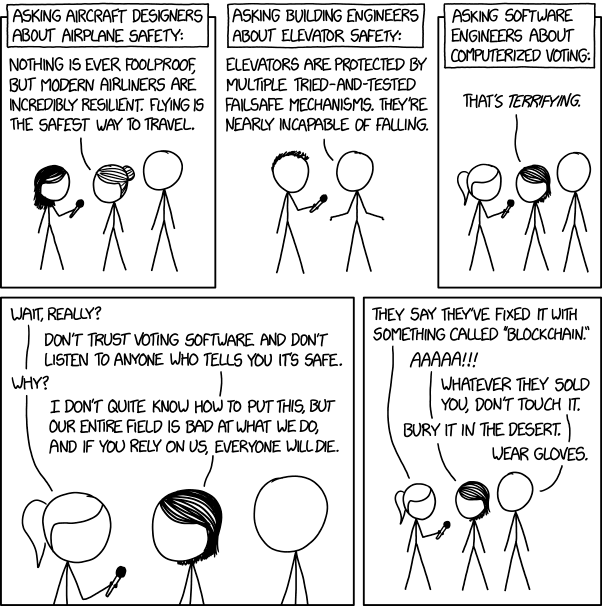
This is not a good idea. I cannot stress this enough. Unlike voting by mail, online voting loses the physical record and is rife with cybersecurity concerns. Because I don’t have credibility on the software development process, I’ll leave this one to the experts:

Via XKCD
Tom Scott explains the concerns well. Highly recommend his channel.

Is normal, in-person voting possible?

Absolutely. Many Americans will vote in person this November. However, voting “normally” might not be as easy as it has been in past elections. In April, the state of Wisconsin ran state elections during the COVID pandemic. Milwaukee, which normally hosts 180 polling locations, had only five open during the election. Polling locations were limited due to a limited number of available workers and locations suited to social distancing. As a result, voter turnout depressed.

So what do I think should happen?

The President’s term will end January 20. That date will not, and should not, change. Congress must certify the results of the election on January 6, I would not change that date either to account for any legal or procedural challenges to the results. Congress should extend the voting window past November 3 for remote voting with a law that supersedes state election laws. States should be given the mandate to keep voting booths open from 8am-8pm minimum, and not close until all who arrived had the chance to vote in a socially-distanced atmosphere (even if that requires keeping polling locations open into the 4th). Additionally, polling locations should reserve a portion of booths for appointment-only voting for those who are in high-risk populations for COVID-19. Those that make it to a pooling location but are unable to vote at the time due to COVID fears or a need to leave before a location is ready, should be given a ballot that can be sent by mail until the 5th.

All states should be required to provide a universal mail-in ballot option. If absentee voting receives bi-partisan support, voting by mail should as well. I doubt that 2020 will set a record for high voter turnout as a percentage of the available population; federal and state governments must making voting as easy and safe as possible.

The key to this approach is to retain as much of the physical voting record as possible. The obvious risk to allowing a longer window for mail-in and in-person voting is that polling stations will receive duplicate ballots. The Federal Government should allocate the funds and resources necessary to allow states to identify and process duplicate ballots correctly. This would be a wise use of funding. States should not be allowed to disclose any results until a pre-determined date when all ballots have been submitted.